Triplogue -
Rajasthan I: |
|
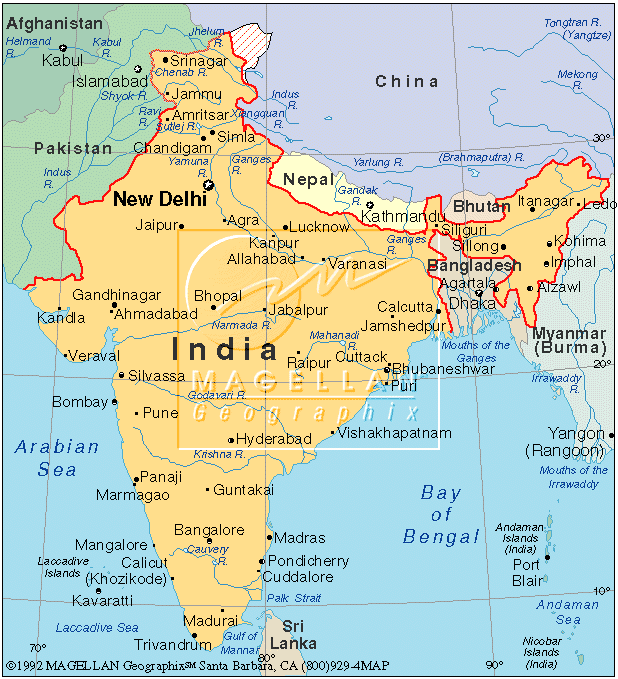
| 15 November, Agra to Bharatpur, 100km (a) "Malaria" the plump, barely-comprehensible hotel doctor had diagnosed following the most cursory of examinations. After scripting me a slew of medications and assuring me that I could bike today, he waddled out of the room and left me to go off and explore Agra fort. It was magnificent, and we had the grand place practically to ourselves –a distinctly different experience than the Taj yesterday. Watching the fading light play off the distant dome and minarets of the more famous of Agra’s monuments, I marveled once again how India’s tourist attractions blow away those of China. This morning I felt slightly better, even managing to swallow a few bites of a sorry buffet breakfast. Getting out of Agra was a bizarre experience, as it was never clear whether we were in the city or the countryside. Agricultural pockets were interspersed among disorderly swathes of Indian urban hell, and our route was neither straight nor clear, forcing us to stop at every intersection and ask stupidly: "Fatehpur Sikri?" and wait for the locals to deliberate before a quorum was reached. While playing dodge-em with potholes, sacred cows, filthy screaming children, oxcarts, camels and an endless sea of teeming humanity, my fever-addled brain pondered on the relationship Indians have with shit. To my mind it’s a major component of what makes this wondrous country so unsettling to Westerners, and to Americans in particular. Shit is everywhere in India, seemingly viewed as an ordinary (and sometimes vital and valuable) element of the organic experience, not something to be flushed away as unmentionable filth. The large numbers of domesticated animals in the towns and countryside alike mean that the streets and highways are practically paved in the stuff. One often sees women and children scooping it up with their hands and lovingly patting it into poop pancakes, which they subsequently sun-dry on any available wall space to be burned later as fuel. These dried patties are kept in elaborately decorated miniature mud huts --little temples erected to the god or gods of excrement. Few landscapes come without a peasant crouching somewhere in the fields, carrying a little can of water to clean himself, while children commonly squat to defecate in the gutter of the street, placidly regarding the bedlam that surrounds them. In India shit doesn’t just happen; shit is. I noticed another thing going out of Agra: Indians are far better cyclists than, say, the Chinese. They don’t swerve randomly and appear to be generally aware of what’s going on around them. The most striking difference between Indian and Chinese cyclists, though, is their relative rates of speed. Indians are fast! We were surprised to be overtaken not by the usual testosterone-laden adolescents trying to prove something, but by ordinary peasants on their way to wherever it is that peasants go. The forty-odd kilometers to Fatehpur Sikri were smooth and fast and flat flat flat. Most of the traffic was cycles and camel carts (a mode of transport to which I have become forever endeared); the only cars were funky Ambassadors –their design unchanged since the 1940’s—carrying pairs of white tourists in their backseats, creating an illusion of colonial times. Some of these post-sahibs stared at us in disbelief through the glass, causing me to think how differently we were experiencing the same road. Another strange feature of this morning’s ride were the literally dozens of dancing bears lining the roadside, waiting to perform for tourist rupees. Fatehpur Sikri is an old capital of the Moghuls, built by Akbar and inhabited for only seventeen years before they moved off to Agra. It is a remarkable place, surrounded by a huge 10-kilometer long wall and surmounted by a citadel containing the religious city (Fatehpur) and the royal residences (Sikri). We stored our bikes in a goat shed and allowed ourselves to be guided around by a friendly and knowledgeable young Muslim. He told us that the bird sanctuary at Bharatpur was only 20 kilometers away on a mostly good road – a fact for which I was glad. My energy had been all but drained, and the final hour of pedaling felt more like six. All along this stretch children would come racing out of the field screaming "Hello pen!", reminding us we were back on the tourist trail, and causing me to curse inwardly the stupid pen-toting tourist who passed through before us. When we reached our shabby, overpriced lodgings within the bird sanctuary I fairly leapt into bed, entreating Fred to explore on his own. He came back raving about the millions of birds he’d seen. Since it is uncharacteristic of Fred to get excited about birds I knew it must be something pretty special. He coaxed me to eat some dinner, where we met a newly-retired English couple who had planned five months in India but now intended to return after just two weeks. Fred listened intently to their impressions as I suspect he’s been planning to bail out as well (though he’s promised me two weeks here before he’ll make any final judgment). India is definitely an intense place, and not for everyone –which for me only adds to its appeal. |
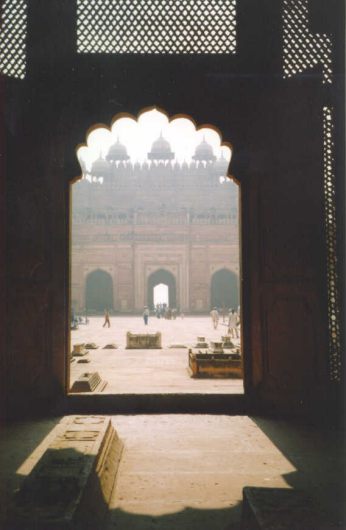 From inside a tomb in Fatehpur
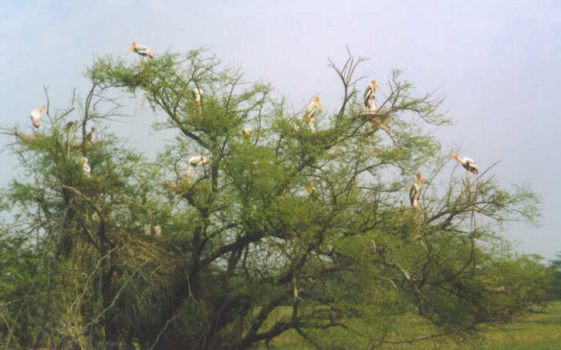
Stork-o-rama in Bharatpur |
 Karmic "No" sign in Bharatpur |
|
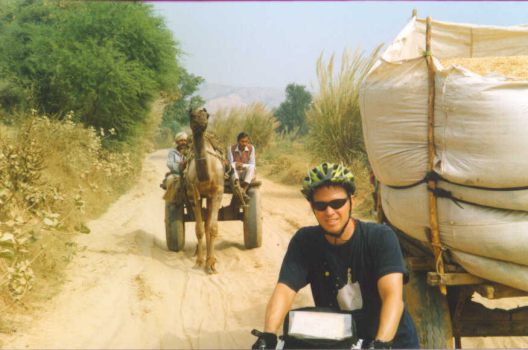 Sandy road to Gangapur
Welcome to Hindaun, mudpuddle capital of India
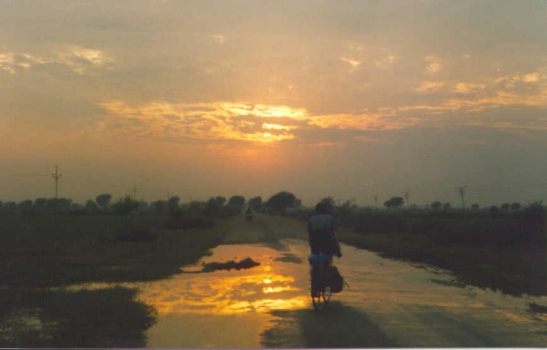
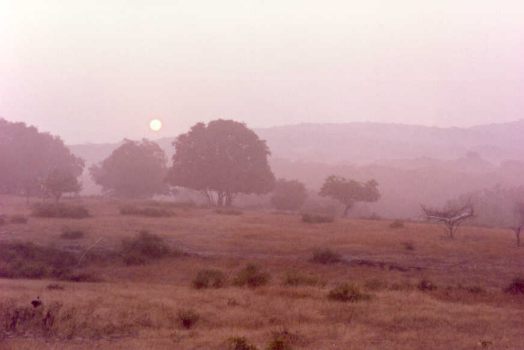
Mudpuddle sunset near Gangapur |
17 November, Bharatpur to Gangapur, 127km (f) I didn’t really expect much from Bharatpur. It was described in our guidebook as a flat piece of land that some raja or prince had flooded so birds would come and he could shoot them. In fact the terrain itself was as uninteresting as can be. Flat as a dosa (an Indian crepe, often stuffed and eaten as a snack or for breakfast) and covered with a grid of roads on dikes there was little to catch the eye in the bird and game reserve. As I began to ride through at sunset while Andy lay in bed I began to understand why people come to Bharatpur. Bright blue kingfishers looked like Christmas ornaments on trees, similarly colored moor hens waddled around in the water and literally tens of thousands of storks nested and tended to their young. While I rode along a deserted path, herons and all types of water fowl flushed from the bushes as I passed, showing me the fanciful designs of their extended wings and tails as they escaped. Just as the sun was about to set over the golden marsh grass I startled a herd of spotted dear who sprinted off into the golden-red light on the horizon. Riding back at dusk I was joined by a legion of bird-watchers and photographers all riding in silence, apparently awed as I was by what they’d seen. The next day I piled still-frail Andy into a cycle rickshaw to try and recreate my experience from the day before, but the sun did not cooperate, so we shivered in the gray morning mist as our Sikh guide pointed out bird after bird after bird. In the afternoon Andy found enough energy to join me on a quest to find the pythons that were supposed to live in the park. We found none; what we did find were a human species of snake. Some Indian kids intent on "befriending" us followed us around, loudly scaring off any bird or other animal we might find an interest in. Beseeching them to leave us alone only made them more ardent. They kept demanding to see our camera which Andy interpreted as a thinly veiled attempt to steal it. I finally was so perturbed by them I asked them to leave us be, explaining that they were not the main attraction at the wild life preserve as hard as they may try. The next day we set off for Gangapur and Andy was more than a little grumpy. I suspect that it was because he was shooed away from the dining room before he finished his second cup of coffee. He had to vacate so that the well-heeled passengers of the Palace on Wheels could dine in privacy. The Palace on Wheels is the upscale way to see India without discovering any of its discomfort. For three hundred a day (dollars not rupees) double occupancy they sleep and eat in the lap of luxury while their carriage is towed through Rajasthan from Delhi. They stop at some of the most fantastic spots and never meet a peasant because their legion of guides-cum-guards insulate them from all things too indigenous. Speaking of locals, some local malady was still invading my stomach and I was wondering if I might have to run out to a field with a little bucket of water to wash after relieving myself. Both of us feeling grumpy led to a little bickering in the morning. Siegfried and Roy sensed the tension and acted up a little, trying to shed their panniers a few times before we actually managed to set off. I realized the profound difference between the Palace on Wheels passengers experience and ours as we loaded the bikes. They streamed off their ultra luxury bus into the care of their guides who’d arrived in advance in sparkling new Range Rovers. All were dressed in designer black and beige outfits except for the occasional tourist in safari wear. They stared at us as though we were freaks, stepping around us like we were dog droppings. Koleodeo National Park had been a little oasis from India, insulated from traffic noises and surrounded by trees, wetlands and wildlife. Now as we passed the gates of the park and left this refuge we were decidedly back in India. The sad excuse for a road punished our butts, pummeled our hands and jarred my head and shoulders. Early in the day the rough road rattled Andy’s bags from his bike. Though so bumpy and broken it was hard to turn my attention from the road there were a few distractions. Rajasthan is full of women so bejeweled it is a wonder that they can move with rings on their fingers, toes, ears and noses; bands on their wrists, arms, ankles. If the women were something to behold we were beholden to the men of the region. At each stop we were besieged by dozens to hundreds crowding around us poking and prodding every part of us and our bikes. Crowds were so dense that it was nearly impossible for us to buy a bottle of water or a bunch of bananas. Most times we’d have to shout what we wanted over the heads of the hoards and have the goods passed to us. We’d send the money to pay through the hands of the crowd with little fear that it wouldn’t make its destination. Starting again was even more difficult. When we mounted our bikes the crowds stood motionless, gaping at our every move but seemingly unaware that we would actually like to leave. I tried everything from pantomiming that I was swimming through the crowd to finally just riding through without regard to anyone’s health or safety. Andy aggressively bike-checked people he became so frustrated, which seemed to rile no one. Just when I thought the road could get no worse it became unbearable. Hundred meter stretches of sand covered the road. We’d approach the sandy bits, drop into our easiest gear, spin until our bikes swayed uncontrollably and fall over or dismount to trudge through the deep soft warm grains. It felt like little doses of the Sahara, and it could be with all the camels passing us hauling huge carts stuffed with cargo. In stark contrast there were more humid barriers to travel. Each year during the dry season the rivers run dry until the monsoon when the raging rains swell them again. The monsoons are so fierce they wash away the bridges so instead they use Irish ones where small streams pass under the bridge but larger amounts of water run over the top. In these instances we’d have to shed our shoes and wade across carrying our bags and bikes. Speaking of water hazards, each town is replete with them. Most houses have no running water so the women go to the wells that are roadside in the towns to pump water and lug it home. Excess water runs from the wells across the road where it combined with the traffic break the pavement into shreds leaving muddy rocky puddles in lieu of a road. The broken roads in towns make the suburban experience unbearable for me and asking the question "How can they live this way?" Because the road is not sealed each passing truck or car creates such a cloud of dust that everyone and everything in a village or town is coated with it. If there happens to be any moisture, the road becomes a muddy slip’n’slide where each step or pedal becomes treacherous. Often the downtown area is a disgusting hybrid of the two where you choke on the dirty air while weaving your way around the dirtiest mud puddles full of water and animal feces. Throughout the day’s ride I imagined the horror of falling into one of these cesspools and religiously avoided the dangerous bits of road, often weaving all over it in the process with my shoes carefully detached from my clips. Through one such region I heard a scream and a tremendous sloshing noise as Andy fell into a mud and cow-dung cocktail. The noise was not unlike that of someone diving into a pool. Expletives streamed out of Andy’s mouth. He’d lived out my worst nightmare. Now brown as any field worker only a little shinier and smellier Andy escaped the puddle, luckily without aspirating any of the muck. This was probably not the first time someone had fallen in the puddle. Almost immediately a good Samaritan appeared and offered to take us somewhere Andy could wash. He took us to a factory courtyard that was empty and showed him the hose. The courtyard was empty until we entered it. Then the workers streamed in to watch the excitement as Andy cleaned as much of the disgusting dirt off of himself as he could. He was more than self-conscious as they intently discussed his every movement and gesture. Besides Andy’s misfortune there were other distractions. The deeper we got into Rajasthan the more interesting the camels got. Their owners seemed very proud of them and perhaps more concerned with their appearance than their wives’. They apply henna and other dyes to their pelts to fashion designs. Many have had their manes died to resemble hair, or sometimes their faces are painted to look as though they have eyelashes, lipstick or mustaches. Almost all have at least bells that jingle loudly as they approach hauling their bulbous loads down the road. The most prized ones have earrings and nose rings. Just as I was about to expire from our 128 kilometers of bone rattling road we arrived in Gangapur. We’d been told that Gangapur was "middle class" and that there were several "good" hotels there. Upon our arrival the locals could only direct us to one, the Raj. Near the very busy train station and upstairs from a pharmacy, it could hardly be classified as nice. The windowless room we were shown had never been cleaned. The bed was covered with rat shit and they weren’t giving it away at 150 rupees. I decided that we should try to train to the next town or find another hotel. After determining that neither solution was an option we paid the room boy to clean the room and went for dinner. On the way we joked about renaming the Hotel Raj to the Hotel Rat in honor of their hygiene problem. Despite the mess I slept peacefully on my own bedding. |
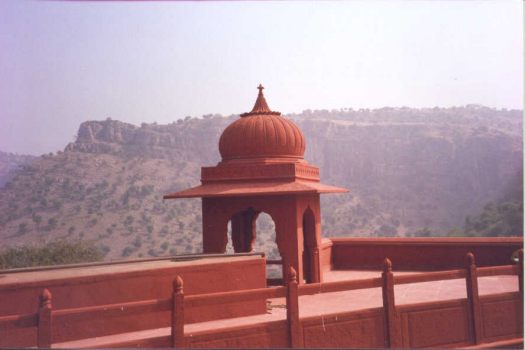
| 18 November, Gangapur to Sawai Madhopur, 101km (a) Today’s was yet another arduous pedal over appallingly bad roads, causing me to fantasize, like Fred, about leaving India earlier than planned. We left our fleabag lodgings shortly after dawn. Mercifully, finding our way out of this charmless town was a lot easier than getting in. Before long we knew we were on the right track when we spotted a milestone indicating that Sawai Madhopur was only 70 kilometers off. "A short day!" I exclaimed delightedly to Fred, who knows better than to share such enthusiasm. And he was right to be skeptical, for never has a short day seemed so long. The sores on my butt throbbed, causing me to stand in the pedals as we negotiated our way through the potholes. Each kilometer felt more like ten, and whenever we passed through even the tiniest hamlet our already miserable road deteriorated into a rocky muddy stinking mess. At a few places along our route we witnessed road repair Indian-style, which consists of several elegant sari-clad women carrying great baskets of rocks on their heads and randomly dumping their loads onto the road’s surface. Apparently the hooves of camels and the wheels of their carts do the rest of the work. The only compensation for our misery was a markedly improved landscape. After days and days of seeing nothing but dusty plains it was a pleasant change to climb through some highland desert. Dramatically steep hills rose off to the south, marking Ranthambore National Park, home of tigers and our destination for the day. It was thrilling, too, to have our first big game sighting on the open road: a nilgai, a huge antelope-like substance I first mistook for a malformed horse, was standing by the side of the road until it spotted us and bolted off into vegetable fields. I had thought our plight might improve when our donkey track joined a busier through highway, but the new road was equally bad, if not worse. With dismay I watched our average speed for the day dip below 15 kph and shut my brain off to make the remainder of the ride more tolerable. Cries of "Hello one rupee" –uttered sheepishly by scruffy roadside kids-- woke me from my reveries and told me we were approaching Sawai Madhopur. When we finally made it to town my energy level had dwindled to nil. Aside from this, I was thoroughly fed up with asking directions every 30 seconds. So we found a sympathetic jeep driver who took us and our bikes the remaining seven kilometers to Castle Jahoor Baori, which sounded groovy from our guidebook’s description. And it was groovy –an old rose-colored hunting lodge perched dramatically atop a hill. The obsequious receptionist informed us that the only available room was the "tiger suite", which suited us just fine. It’s easily our funkiest lodgings yet in India and the general romance of the place makes me feel like we’re finally in Rajasthan. After being told that we could join a tiger safari departing in just minutes, we scarfed down a lunch and jumped into the waiting canter (like a dumptruck with seats in the back). Fred regretted our decision as soon as the truck tore down the perilously steep hill from the castle. While the driving was a bit on the fast side I figured it afforded us a more extensive view of the park, as well as a better chance of seeing a tiger. No tiger was spotted, although we did see some tracks, as well as a whole host of other critters: giant elk-looking deer called sambhars, smaller spotted deer called chitals, wild pigs, antelopes, crocodiles and a mongoose. The whole place was teeming with life; no way a tiger could go hungry here. I was especially blown away by the park’s extraordinary setting amid lakes and forests atop a huge plateau. To get there you have to climb up a steep gorge, before passing through a series of ancient gates, all the time looking up at the massive walls of an ancient abandoned fortress. The park is strewn with ruins of royal pavilions from which the maharajas would shoot their quarry. Back at the castle we met a charming young Indian visiting from Ahmedabad with his family and friends –numbering fifteen persons in all. They were all visibly excited. Satya explained why: "Yes, we saw not one tiger but two. The second was stalking a deer. If you’ve taken the canter today you really must get a jeep for tomorrow, since they can take all the tracks." Enthusiastic young Satya was someone we would have liked to get to know better, but unfortunately he had a train to catch. "I’m performing as a dancer on the Channel V Music Video Awards," he explained. Could this member of Gujarat’s jeunesse doree also be a sister? We both wondered… We gladly accepted his address and phone in Ahmedabad so we could continue our inquiry. It’ll also be interesting to get a glimpse of the culture of privileged Indians, who strike us both as even more friendly and open than Americans. The next morning we forewent the expected (by everyone around the place) tiger safari in order to do some laundry and catch up on our relaxation. Both were accomplished on the castle’s fabulous rooftop terrace. As lunchtime approached, we figured we’d go on an expedition into town to book a jeep and to check out the area’s leading hotel as a possible birthday treat for Fred tomorrow. Arranging our jeep safari was predictably complex. The office was closed by the time we finally found it, so we headed back to the Sawai Madhopur Lodge for an elegant and tasty lunch. A peek at a suite convinced Fred that he wanted to stay there for his birthday, then it was back to the Project Tiger office to book a jeep. Once there, we figured we’d go on the afternoon canter tour again and were told we’d be picked up at our hotel at two-thirty. So we hightailed it back up the hill and waited, and waited and waited. We had been told several times that the safari booking office had no phone, but when our ride was fully an hour behind schedule, the concerned receptionist made a call. A voice on the other end told me that the negligent canter driver would be reprimanded and he’d send us a jeep, right away. All I needed to do was write an official explanation of what had happened to feed the bureaucracy. And all worked out well, or so we thought. The jeep whisked us up the hill to the reserve, where we even spotted a tiger lurking in the shadows under a distant tree. Upon our return to our lodgings, however, the tiger office wanted to talk to me again. This being India, we weren’t terribly surprised when an anxious-looking receptionist interrupted our cocktail hour, wringing his hands and saying, "You have a visitor, waiting for you in the lobby." Of course it was the P.T. director. He motioned us to sit down and stated in a comically grave voice, "We’re making an inquiry." I felt as if on trial, calmly reporting the facts as they had occurred and reiterating that I had played no part in the ticket seller’s alleged confusion. So much drama over something so trivial! Had we known what trouble it would all be Fred and I would have much preferred an afternoon of vegetation on the terrace. But at the same time the whole episode gave us a glimpse into the strange machinations of bureaucratic India. Nodding off to sleep I wondered, though, if in such an "inquiry" the Indian is always proven right and the outsider wrong. |
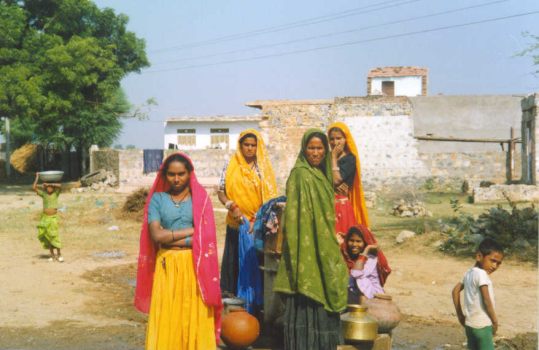 Roadside color
Our Ranthambore digs
Sunset in Ranthambore |
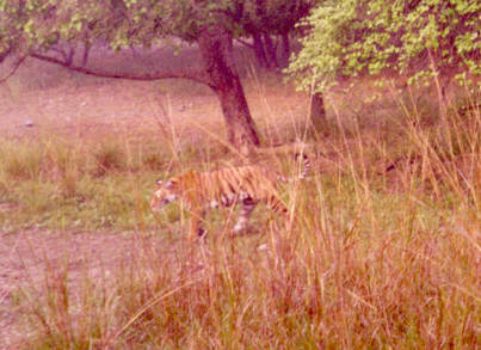 Early morning spraying rounds
With a few trophies in Kota
|
20-22 November, Sawai Madhopur/Kota to
Bundi, 66km (f) This is the year of the tiger, I was born during a year of the tiger and I was bound and determined to see a tiger on my birthday. The safaris we’d taken so far had been great, we’d seen tigers at a distance, hundreds of deer, wild boar, peacocks and tens of other species. Our trips through the park had a "Raiders of the Lost Ark" feel to them as we motored through the jungle past stone structures being engulfed by vines, misty ponds full of crocodiles. We’d yet to see a tiger up close. At 5:30 in the morning of my birthday my happy dreams of frolicking with big teddy-bear like tigers ended with the buzz of the door of our hotel. Our breakfast and coffee had arrived a half hour earlier than we’d agreed. Like clockwork Rasheed our guide arrived and we were bouncing down the road in the tiny open jeep to view the tigers. This morning the park had the same quality that it had in my dreams due to the thick cloudy mist. I shivered as the wind buffeted me. We entered the reserve and Rasheed came alive. His small black eyes shifted rapidly from side to side as he surveyed the underbrush for our visual prey. Six other jeeps and two open top busses were engaged in the same pursuit. Just as the day before as we crossed the others we’d stop and the drivers would chatter at one another in Hindi (or was it Rajasthani) the conversation unintelligible to me except when they’d say "sighting" or "tiger". After only a few minutes in the park we found the trail of our tiger. Fresh paw prints in the dusty road told us he or she had passed just a few moments before us. To my surprise we came upon her in just a few moments. Rasheed explained that they like to walk down the road because it is easier than going through the brush. Two other jeeps were already there and the canters (open top four wheel drive busses) were just behind us. No one paid any attention to the sign that stated "If two vehicles are at a sighting the third must move on". Like a house cat awakening from a nap, the huge beast extended its paws, stretched and walked just a few feet from the jeep in front of us. I wondered if it thought that the enormous British woman in the jeep in front of us looked tasty or not? As it passed a tree it lifted its tail and shot a burst of spray, marking its territory before sauntering down the road. Surprisingly it seemed oblivious to the presence of the six vehicle parade behind it. When it reached the T-intersection at the end of the road it continued off into the forest without looking back disappearing into the mist and the thicket as carelessly as it had appeared. As we searched for more wildlife I started to think about the tigers’ eating habits. They each eat two spotted deer or one sambar a week. There are 27 tigers in the park and they each hunt only for themselves, not sharing their kill with any other tiger. They can eat up to 25 kilograms of flesh per meal. (the population of tigers in the park eat 2100 animals a year) I wondered why they don’t eat us? There we are sitting in an open jeep a few yards from their razor sharp teeth and powerful paws. When we returned to the hotel I was happy, I’d seen my birthday tiger and was ready to celebrate the year. The following day couldn’t have been a day of greater contrasts. The squalid and fetid train ride to Kota framed by elegant meals in over decorated dining rooms. Though, other than the service, we were the only humans at breakfast, I felt we were being watched. Perhaps it was the forty plus glass eyes of the hunting trophies staring blankly at us. I wondered if they might break into song or start a conversation like those in the Disney attraction, "Country Bear Jamboree". Tiger and leopard motifs prevail in the dining room of the Taj Hotel in Sawai Madhopur. The rooms’ carpets, napkins, tablecloths and picture frames all carried the pattern of pelts. After breaky we were off to the train to Kota. Though off the bikes for two days my butt could hardly bear another day of the beating that the Rajasthani roads had dished out. All the intelligence about the 130 km to Kota told us that it was more of the same. We were promised by all that the road after that was exquisite. I preferred the idea of taking a jeep, but Andy was insistent on the train. He thought it would be more comfortable, faster and ten-fold cheaper. He was right about the "cheaper" part. In fact, the fare was less than a dollar each and another for each of the bikes. Getting information about trains and how to put the bikes on it would prove more complicated than any border crossing. Matters were further confused by a derailment of the Delhi-Bombay train that shared the tracks with ours. Finally, with everything arranged we went out to the platform to wait for our train. We were about to board when we noticed that our bikes were sitting on the platform and not loaded onto the train. Stepping off we argued that they should be loaded only to be refused. I suspect that we were too slow to baksheesh the porters and conductor. Good fortune shone upon us, sort of, because a local (read: so slow you can’t believe you’re not walking) train arrived shortly thereafter taking us and our bikes honoring our (more expensive) express train tickets. After boarding we found a place on the same car as our bikes. No seats but there were primitive bunk berths mounted in the open car. We found a lower and installed ourselves much to the dismay of the peasants we evicted. They moved to the opposite bunk, faced us and watched us like an in-flight movie for the next three hours. The car was filthy, it may never have been cleaned and smelled like it might have been used to haul goats to market the night before. We passed the next three hours reading, writing and playing cards. Somewhere along the line I bonded with our peasant neighbors by sharing my throat lozenges with them. They reciprocated offering peanuts, snacks and cigarettes. When we finally arrived we found that there were no baggage handlers to open the car and give us our bikes. Andy went to seek help while I remained with the car. It was a ridiculous game of hide the bikes for the next half-hour. I had to follow the car around the station like a lost lamb as they towed it around to-and-fro seemingly without reason worried all the time it might be spirited off to another station. Andy got more and more frustrated and vocal as we spent an hour trying to find our bikes. Finally I found them again across the station. They’d been unloaded and were in the process of entertaining a crowd of travelers and station workers. We entertained them further as we assembled our gear and attached it to the bikes before departing the station hastily. More in keeping with our morning, we arrived at the stately palace of Kota on the banks of the river. Sadly the proprietors would only take cash for the room which left us severely short of currency in the middle of a weekend. We did have enough to go to the saddest museum on earth. Its only exhibit of interest was the armory filled with ferocious looking knives, daggers and swords. On top of being a bad museum with crumbling exhibits it was prohibitively expensive, especially with our cash constraints. At over a dollar it was the worst tourist value in India. Most sites in this country are free or cost only pennies. More depressing was the obvious fact that the workers at the museum seemed to be very badly off. Some of them begged for cash as we walked the halls. Heading back to the hotel we rode our bikes through the center of Kota. Its narrow streets were flooded with humanity on all forms of transportation and more bovine hazards than we’d seen anywhere. A few weeks before I wouldn’t have dared pedaled my bike, laden or not, through the dense pack of people and cows. Cyclists, scooters, autorickshaws (three-wheeled taxis based on scooter drive trains, like small tuk-tuks) flowed like water in a stream past bustling shops many selling jewelry and cloth. We began to wonder what portion of disposable income is spent on women’s clothing and bangles. We spent an hour trying to find someone who’d exchange some Yankee dollars for Indian rupees to no avail. It was surprising that no one would, since it hadn’t been a problem before. We had no luck whatsoever except, by some miracle, the hotel extended us credit at dinner. The dining room and living room of the palace looked as though the family still lived there, though we knew that they’d retreated to the upper floors. Replete with photographs, memorabilia and hunting trophies one wondered if time had stopped. One photo depicted the maharaja with a dead tiger. In his hand written below he bragged that this was "his 82nd kill on foot." I was curious whether it was 82 a pied or 82 tigers total? It was hard to guess considering the seemingly endless number of trophies on the walls, stuffed and freestanding, rugs, pelts and other animal products in the palace. The Prince of Kota made an appearance at dinner. Dressed in aubergine silk pajamas he greeted us. He’d studied at Brown and Columbia and was very well spoken. I was curious how he dealt with the poverty of his people. The next morning the prince was absent, though one of our fellow guests appeared. Mitch Crites was the first to arrive. An American, he’d been in India for over 30 years. Here he’d married a Persian woman and converted to Islam. Mitch had taken his academic background in Indology and Archeology and converted it to commercial use. Mitch had revived the crafts of stone inlay, calligraphy and stone carving of the Moghul emperors. Currently he is engaged in building the new national mosque of Malaysia. Besides being a fascinating breakfast companion Mitch saved us that morning. At breakfast the hotel staff became more and more insistent that we settle our bill with cash at that moment. Two young men in pseudo military garb stood over us demanding payment even though I’d explained that we would need to go to the bank or another hotel to exchange that morning before leaving. Mitch came to the rescue; he was flush with cash, knew the value of a dollar and was willing to help. After our embarrassing situation was averted Mitch’s friends arrived at the table. Howard and Jane proved to be good company as well. Howard had the appearance of a gentleman archeologist which he apparently was. Mitch and he had met some thirty years before on a dig. After sharing our impressions of India we set off for Bundi and bid adieu to our new friends amid promises of keeping in touch. As we pedaled off the prince made one last appearance and pitched his website. Finally we hit the fantastically smooth road to Bundi. On the road we passed more bicycles than any other traffic. The most annoying traffic, as usual, was the motorcycle and scooter traffic. Not because we were fighting for the road, but because of the method of passing. Each comes up beside us, stares, pulls ahead, realizes that we are weird, drop back next to us and begin to question us. Where are you from, what is your name….? And on, and on…. Not that I don’t appreciate their friendliness; It is just inappropriate on a motorcycle. First, it is hard to hear them. Second, it is dangerous because they are such terrible drivers. Third, their mounts are noisy and stinky. And last, the passing traffic honks insistently behind us when they ride next to us. It just makes the riding experience entirely unpleasant and unsafe. Speaking of unsafe the roads are pretty bad if you don’t understand the rules. Once you do there is little danger. The big and important rule is that you yield to anything bigger than you. If you have any question whatsoever about your safety get off the road. And we do; twenty, thirty, sometimes fifty times a day we ride onto the shoulder (or into the ditch) to avoid oncoming traffic. Those who don’t pay the price. Every day we see the remnants of cocky behavior, usually in the form of a pair of trucks or busses that crashed head-on. The grisly remains of the vehicles, usually bent, burnt and busted, are often splattered with the blood of the victims. The hulks sit on the roads for days after the events with guards protecting the contents of the trucks and the salvageable parts of the vehicles. Today we saw an especially gruesome one and stopped to try to figure how it had happened. Upon arriving in the ultra quaint town of Bundi we found lodging in the upper part of the town near the ancient and now deserted palaces. The three hundred year-old haveli was filled with charming little rooms decorated like traditional Indian homes. Howard, Jane and Mitch had recommended that we find a guide named JP who had led them through the palaces and somehow had access to the locked regions that included frescoes that were 500 years old. We found him outside of our hotel and arranged a hike after our lunch. Our hotel proprietors did not like the young man and counseled us not to use him. He’d extracted money from some other tourists in some scam that was too complicated to understand. I kept on my guard after the warning but we still decided to use him. It turned out to be a great hike and his services were super helpful despite our hotelier’s concern. The hillside palace and fort looks down on the hilly medieval looking town. We were awed by the view and the beauty of the surrounding terrain. After a feast of a meal we started on a nighttime walk around the town. It was the most charming of all the cities we’d been in so far. Elections were about to be conducted in Rajasthan and the town was abuzz with pre-election activity. The most common promotion of candidates were vehicles with huge speakers attached playing audio taped slogans, sales pitches, songs and speeches. I was glad that all of this was to end then next day as polling was to begin. I felt a subtle shift in my appreciation of India this day. Was I beginning to like it? |
|
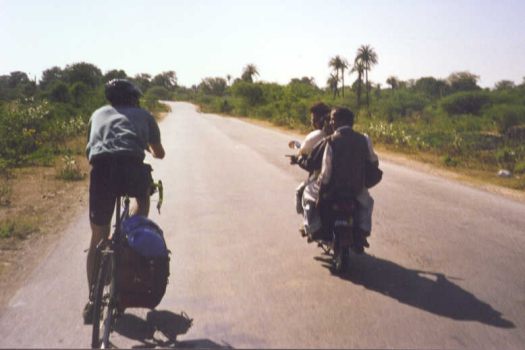
Making friends on the road
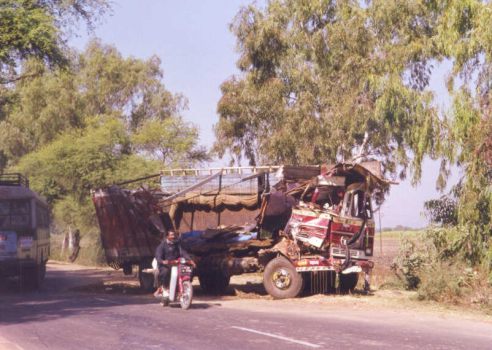
An all too common sight on Indian highways
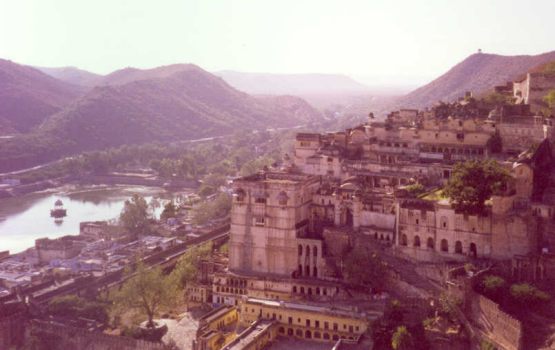
Bundi's palace |
© 1997 Frederick Felman and Andrew Broan, All rights reserved. No part of this web site may be reproduced in any form or by any electronic or mechanical means without permission in writing from authors or their agents.