Triplogue - China IV: Zhejiang |
|
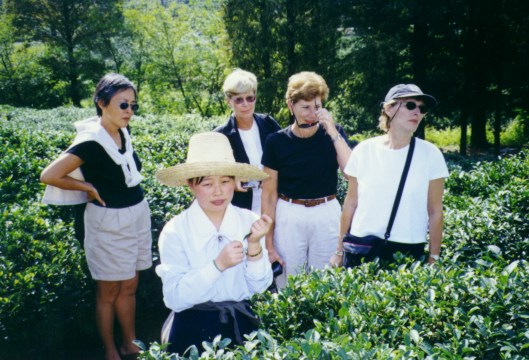
| 3-6 October, Hangzhou (f) Boarding the train to Hangzhou I couldn’t understand why all the fuss about getting tickets. Many seats were empty and there weren’t that many stops before Shanghai at times folks could want to board. To further complicate matters Andy and I were in separate cars so I’d have to find my berth with my totally inadequate language skills. It was a little confusing because all the berths seemed to have the same number. A helpful guy saw my confusion and nearly grabbed me by the hand and led me to my place. For "hard sleeper" it seemed pretty soft. I might have thought differently had I been in the third bunk up, but my ground level digs seemed do-able. There were a few things I worried about. First were the fluorescent lights that could not be controlled by anyone but the conductor. Second, a loudspeaker blared announcements and communist propaganda and it was located just above my bed. Lastly, most folks on the car had cell phones that they seemed to be constantly shouting into. Just when I had resolved that I’d be spending the night alone in this little nightmare Andy showed up and explained that he had negotiated berths together in his car. There wasn’t much difference in the cars, but we could at least play cards and backgammon together until we could try to sleep amidst the bedlam. Andy had made friends with the conductor of his car and she was determined to make sure we had a good trip; she even presented us with an enormous pomelo as a gift. We’d asked her if she could find us a place in soft sleeper and the answer was "yo" (yes). For something less than 100 agoutis we could turn off the lights and announcements; this seemed like a great deal to me. A few moments later we were snug in a quiet compartment and dreaming about seeing Andy’s dad and his friend Leslie. A nightmare I was trying not to consider was getting our bags and bikes from the luggage service upon our arrival. It had been a very Chinese experience getting them on the train in the first place. We’d arrived in what I’d assumed was ample time with more than an hour to deal with the baggage service. When we got there they did their best to ignore us in the little glass and iron bar lined cage that stood near the entrance of the warehouse. We rapped on the windows and shouted into the little air holes until someone emerged. A dozen forms and some RMB later the bikes were apparently on their way. At the last moment there was some sort of a hitch. We’d have to take insurance on the bikes and bag and declare their value. Even though we discounted the value of the goods by 75% everyone was shocked and stared at us. "No, it couldn’t be that", they kept repeating. We looked at one another and thought, "then why ask us?" Somehow the problem cleared itself up and they were taken away, only we’d forgotten to ask when they’d arrive. Andy went back to ask and found that they were sitting in a pile with a ton of mail. They said to him "oh, would you like them to go on your train?" How he restrained himself from answering "No, just grind them into bits, bake them into some mooncakes and send them to us during the next century," I don’t know. He just said "Yes" and they were magically transported to the train. When we did arrive in Hangzhou getting the bag and bikes was not so difficult at all except that we were a mess. There is something most uncivilized about arriving at a destination before six in the morning. Further complicating things we were some distance from the center of town and Jack and Leslie’s hotel. (We’d find out later that we were much closer to their hotel then we thought.) As the sun turned the sky from black to grey we batted mosquitoes off our extremities while seeking directions into town. When we reached the lakeside and the location of their hotel Andy went in and asked if this was the Hubin Hotel. They said no and that there was no Hubin Hotel. He came out with a long face and explained the problem. Jack and Leslie were to arrive the next day and we had no idea where they were staying in this town of over 2 million people and probably as many tourists. Luckily there weren’t too many occidental tourists. Trying not to panic we started canvassing every hotel in the area for a group of Americans whom would arrive tomorrow. Sounds like an easy enough task doesn’t it? Try again! -- You must factor in the China factor. Many of the desk clerks were eager to help us, still others visibly wished we would die or evaporate and would do almost anything to be rid of us. After three hours search and a dreadful night’s sleep on the train we decided to have a rest and checked into the most helpful of the hotels. There the front desk staff vowed to help us find Andy’s dad. After a nap we decided to be tourists for the afternoon, thinking that it would be easier to locate Jack after he’d arrived. We took a spin around the lake on our bikes, finding it hard to go wild over the scenery everyone had raved about. It was a charming location, with a big lake and pretty trees but the sky was so gray and obnoxious taxis and busses tried to run us down at every intersection. It didn’t help that we had the task of finding those guys looming over our heads. They were to arrive the next day in the evening so Andy and I started canvassing hotels on bike after the front desk of our hotel reported no success in finding them. We’ thought we’d found a lead at one fabulous commie enclave. They were expecting 19 foreigners that night and we could call later when they arrived. We sat around our hotel room playing cards and calling every hour until at around 11pm a bus of Taiwanese arrived, smashing our hopes for finding them. We went to sleep utterly dejected, especially after knowing what we went through to get to Hangzhou. The next morning I asked the front desk of our hotel if they’d had any luck. No, but they’d try a few more hotels. While we waited they did and came up with nothing. I pleaded "is there some hotel you might have forgotten? Perhaps something near the railway station?" Ding! The light went on in her head and she called the Crown Hotel, which miraculously had a group of Americans staying there, including Andy’s dad. Our search was over. We arranged to meet them at the lake and join them on their day of tourism in Hangzhou. The first event was a boat ride around the lake, which turned out to be perfect opportunity to catch up with Jack and Leslie and meet their fellow tourists. They were on a tour of the three treasures of China – tea, silk and pottery-- with the University of Wisconsin. Luckily the tour was led by David Buck and his sidekick Innes, both very calm and flexible people. They happily invited us to join their activities. After the boat ride and lunch we were off to a tea plantation to sample Dragon Well green tea. The tour of the tea plantation began amongst the tea bushes just next to where the bus stopped. A rosy cheeked girl of 25 with perfectly manicured nails, a broad smile and wearing tea collection baskets said "Pleazascusamee, I speak eeengleesh only a little" before powering articulately through a rather well polished speech about tea and how it is harvested. She ended with an explanation of how her back hurt her after a day of picking tea. It was hard to believe from her appearance that she’d actually picked any tea in her lifetime. Next we were hustled off to a tasting room where a presentation more slick than the best infomercial sold almost everyone in the group a $25 tin of tea. I marvelled at their marketing skills and then remembered they’d had centuries of experience with this sort of thing. The next stop was a silk factory. Andy and I had both anticipated seeing a huge room with thousands of cocoons and happy healthy worms being force-fed mulberry bush. What we found was a little museum showing how this process worked, some examples of silk and a tour of a factory full of complex looms pounding out intricate silk cloth. One of the best displays in the museum was that documenting Clinton’s recent visit and how they constructed the loom program that made a silk tea towel with his image. We wondered if they were working on a Monica towel in keeping with current events back in the states. We excused ourselves after the silk factory and rejoined Jack and Leslie for dinner with their group. Afterwards we’d promised to take them out for a fantastic pastry desert at the Novotel after a walk through the night market. Jack and Leslie seemed a little bored by the market and our search for kitsch there. They’d seen one too many Mao clocks by the time we headed for the hotel. To make matters worse we arrived too late at the hotel and all of the pastries were sold out. A further search for the ice cream vendor we’d found the previous night on the lake was fruitless and we finally sent the exhausted pair back to their hotel empty stomached. We were satisfied and happy we’d finally connected with them and made plans to meet again in Shanghai. |
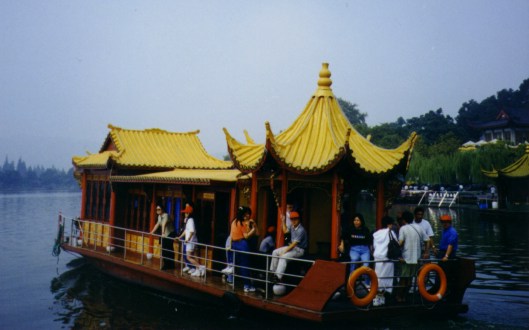 Floating pagoda on West Lake
Milwaukee gals learn about tea |
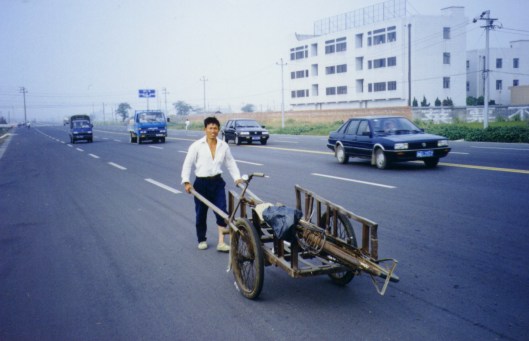 On the road near Xiaoshan
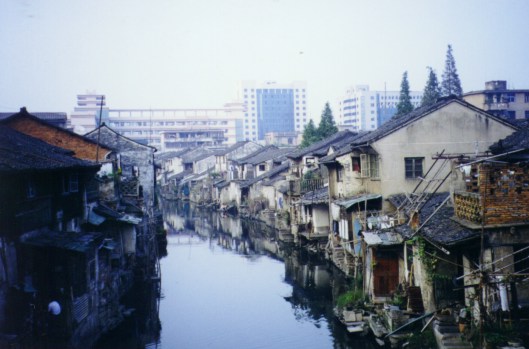
Canalside housing in Shaoxing
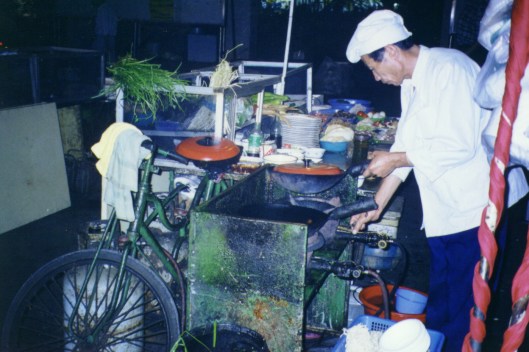
Pedal-powered restaurant |
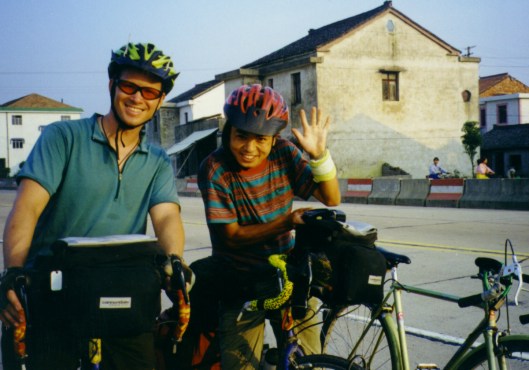
7 October, Hangzhou to Shaoxing, 65km (a) Riding out of town on the now-familiar road that circumnavigated West Lake, I couldn’t help but notice how Fred has perfected his rendition of the "Chinese National Anthem." It’s basically a two-note tune, consisting of a prolonged and high-decibel clearing of the throat and nasal passages, followed by a sharp and (hopefully) well-aimed spit. It’s a tune that is quite literally infectious in this part of the world, and one I won’t miss when I leave. We were following a pre-described route for a change, prepared with a precision bordering on anality by fellow Santa Cruzan Roger Grigsby in "China by Bike." I’d been lugging the book around for months and it felt good to be finally putting it to use, not to mention having someone else in the driver’s seat. Leaving the park-like surroundings of Hangzhou, we crossed a bridge over the extra-wide Qiantang River. I gazed down into its murky vastness and wished we’d stayed an extra day in order to witness the annual "tidal bore," a phenomenon that occurs but once a year, three days after the closest full moon (which happened two nights ago). The lunar pull of the tide is so great here that it creates a mini tidal wave that can reach many meters tall. Jack and Leslie’s guide told us that many too-curious people have been killed by it, but that the height of the bridge makes it a safe vantage point. He also told us that the bridge had been destroyed twice in its short history, once to keep the Japanese army from advancing, and once to keep out the Communist forces. Its most recent incarnation doesn’t date back very far, yet it wasn’t really designed to accommodate bikes. We had to ride on the narrow sidewalk and play dodge ‘em with elderly fishermen. Our guidebook described highway 104 as carrying "light traffic", but it was published four full years ago –an eternity in hyper-developing China. Now the narrow road is packed with trucks and –gasp—private cars, all busily transporting goods and people through this prosperous region. The villages were unlike any others we’ve seen in China: all the houses here are vertically oriented, of very recent construction and often surmounted by miniature Eiffel towers. Each village –and they were everywhere, sprouting up like miniature Manhattans out of the rice fields—boasted at least one "nouveau riche" style house complete with turrets and domes and lots of gold trim. When we saw a new and empty road y’ing off to the right, we couldn’t resist. So much for sticking to the route (neither of us has ever been very good at following other people’s directions). Big bike lanes led us into the big futuristic town of Chengxiang (also known as Xiaoshan), where we hooked back up with highway 104. The road became even busier from here, and didn’t feature shoulders. We were surprised, though, by the relative civility of the traffic. The air was noticeably chemical-smelling from all the industry and I thanked the Void that I didn’t have to live in such a place. We pedaled swiftly through a flat landscape of rice crisscrossed by a network of busy canals, the horizon broken by an infinite number of concrete villages. There are a lot of people in Zhejiang province, and they all seem to be very actively scuttling about looking for that next yuan. As we neared Shaoxing a couple of morons on a scooter acted as our escorts into town, riding alongside us for the better part of an hour. We checked into the first hotel we saw, thirty stories high and brand spanking new. We had made good time from Hangzhou and were able to shower before lunch –a rare luxury for us. On our long walk around this fascinating town, we were surprised to find many little corners of old China tucked away in the shadow of skyscrapers. Old stone bridges crossed ancient canals lined with little wooden houses. Overall, Shaoxing struck us as a friendly, civilized place. One street we walked down looked more like a market town in Denmark than anyplace in China –full of bikes, tidy and discreetly rich. Fred referred to this part of Shaoxing as "Beverly Hills." We also walked by Zhou En Lai’s ancestral home, followed by a tasty dinner in the street and a funny conversation with some Uighur minority people from far-flung Xinjiang. Seeking refuge from the skeeters, we headed back to our hotel for a relatively early night. Our hotel room was mercifully mosquito-free, though not without pests. As in literally every other hotel we’ve stayed at in China, the phone rang with a girl offering her services. "Ao Mo," (massage) they say, or simply "xiao jie", meaning "little miss." They don’t try just once or twice either, and have no qualms about ringing in the wee hours of the morning. We call it "dialing for dollars" and have learned to deal with this nuisance by unhooking the phones (yes, plural phones, since Chinese hotels invariably feature phones in the toilet). The next morning I was surprised to be awakened by the sound of a phone ringing. Fred had woken up early and reconnected the phones so as not to freak out the maid. I foolishly answered, and a breathy female voice, sounding a bit desperate now, urgently said once again, "Do you want a little miss?" I don’t know the Chinese word for "persistence" so I complimented her in English before declining as politely as possible and hanging up. |
| 8 October, Shaoxing to Yuyao, 104km (f) The old parts of Shaoxing were among the most interesting bits of urban old China we’d found on the trip. Consequently we decided to take a rather complicated route out of town. First we travelled north through the adjacent rice fields and canalside suburbs. People were visibly surprised to see a couple of whities cycling through their villages and I was entertained by how rural life existed so close to such a cosmopolitan city. We joined the commuter crowd in the bicycle lane back to central Shaoxing. There we’d planned to visit the ancestral home of Zhou En Lai, the much-revered former premier of China. He’d tempered Mao’s excesses and is still very much in favor here in China. The little museum that stands as a tribute to him is in far better shape than that for Mao in Shaoshan. While we visited the shrine our bikes were once again the center of attention. My cold was again bothering me and I was in a bad mood. When we stopped for some noodles and soup my attitude perked up and we were on our way to our next tourist stop. The pagoda was dedicated to a great emperor ("Da Yu") credited with taming the savage floods of China. A grand affair behind massive walls and a moat-like canal that had been destroyed and rebuilt a number of times stood before us. I decided to rest on the ancient stone bridge and read while Andy explored it. To my surprise the Chinese tourists that arrived left me be and my only companion was my book and a canal boat captain. He was intent on a ride down the canal and seemed to insist that he could take me as far as Wuxi. (This seemed most unlikely, as Wuxi is still some distance from Shanghai that was a few days by boat and bike away.) When Andy returned I was much restored. We had a choice: ride down the (nasty, crowded, straight, smoggy and boring) highway or explore a new route through the foothills. We both voted for the latter and were rewarded with some of the most beautiful terrain of the trip. A tree lined asphalt strip with light traffic wound through the valleys past ready-to-harvest rice and over hills covered with tea. The tea bushes are trimmed to form rounded hedges that follow the contours of the hills. The result was scenery that looked like a living topographical map. Going over the largest pass of the day the road deteriorated into loose gravel and traffic dropped off nearly completely. When we coasted down into the next valley the bitumen resumed. Andy was several hundred meters behind me. So when I passed a lone rattan chair sitting unoccupied on the roadside I hopped off my bike and sat in it and waited for him under the trees. Seemed an unlikely place for a chair there in the middle of nowhere. Our map wasn’t very helpful and we were out of the range of our cycling guide so we stopped frequently for directions under the again warm sun. Later we passed through an enormous town that looked like it was built yesterday, Xiyu. As we did so we crossed a massive suspension bridge crowded by what looked like the entire town. We couldn’t figure out why so we stopped to investigate. We were told that the tidal bore (a sometimes massive tidally induced wave) was on its way any minute. We parked our bikes on the bridge and joined the masses. We were somehow immune to the police who insisted that the Chinese get their bikes out of the traffic lanes while letting ours be. While waiting for the wave we were far more interesting to the crowd than the river. People would stroll the bridge pausing to examine our bikes, helmets and us. A beggar we’d given some coins to some kilometers back caught up with us again and was demanding more change. Though we insisted he leave with the crowd’s support he remained in our face. Andy pulled out the squirt gun and let him have it. The crowd roared with laughter and the derelict departed. A few moments later the crowd silenced and the meter high wave washed upriver. How the wave travelled 40 miles upriver remains a mystery to me but there it was. It passed the bridge and as though choreographed, the crowd walked from one side of the bridge to the other, watching the wave proceed up to the next town. We hopped on our bikes and joined thousands on their return to the city. Leaving town the road opened up into four lanes and a bike lane and we pumped our pedals against the afternoon wind. Some kilometers out of town we ran into another cycle tourist. With long hair and a queeny demeanor he was pedaling back to Hangzhou which "is a lot of fun." He didn’t like Yuyao, but was still willing to turn around and pedal there with us if we wanted. We politely excused ourselves and went onward alone. He had claimed that he’d be in Hangzhou in just a few hours. That couldn’t be possible even if he were the fastest bicyclist on earth. His destination was some 150 km away. No matter what his ride would be in the dark as the sun was setting. Even with his unconventional riding habits and sense of time and distance he was the most professionally outfitted Chinese rider we’d met. He sported a helmet and a real (though Chinese) touring rig with gears. With all of our stops we’d be hard pressed to make our destination against the wind before dark. We pedalled hard and made it to the outskirts of town as the last light was fading. That was when I heard my least favorite noise emanate from Andy’s bike. A short loud bang followed by a hiss indicated that his tire had blown. We hastily patched with a small audience of 15 cyclists who stopped to peskily pinch our tires and shift our gears and marvel at why we’d change our own tires. "Where is the best hotel in town?" we asked a cop near the entrance of town. He directed us to the Grand Pacific Hotel – Ningbo. It was shockingly grand and new, but still 60 km from Ningbo. It led us to believe that no one knows where Yuyao is so they must identify themselves with their larger neighbor town. Checking in we heard a North American accent shout out "What the hell are you guys doing here?" Enter Randy Cooper, the Vice General Manager of the hotel. Doing a year’s stint to help the hotel open successfully and finding not much in common with his adopted hometown in Hawaii. A warmer welcome has not been extended to us in some time. Randy’s attitude was perfect for China. His efficient manner and smiling countenance must have been invaluable as he surmounted the doubtlessly frequent and hopelessly complicated problems of opening a hotel in such a town. Recently wealthy but hardly upscale Yuyao is probably a perfect place to open a manufacturing business but nearly impossible to run a hospitality outfit. Whatever his challenges Randy seems to be doing a bang-up job and enjoying himself to boot. Regarding the attentions a westerner gets --himself included-- he said it best: "Where else can a half-bald, overweight fifty-year-old man be queen of the prom?" |
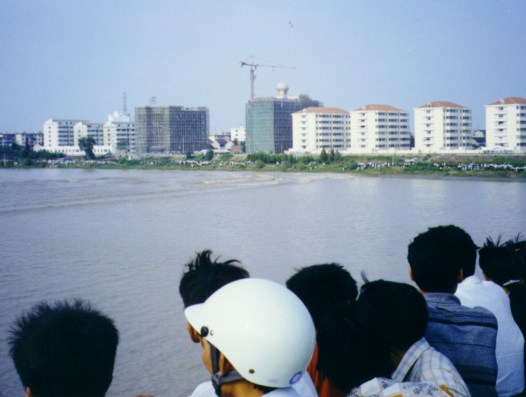 Tidal bore hits Xinyu
Macho cyclist on his way to Nanjing
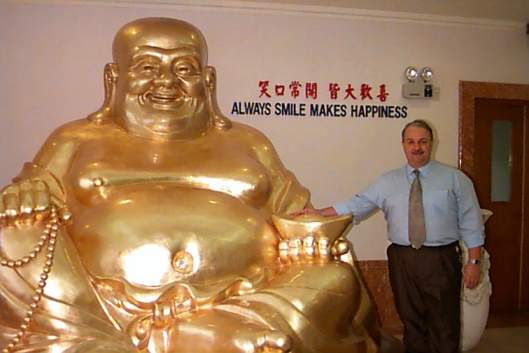
Randy -- our friend in Yuyao |
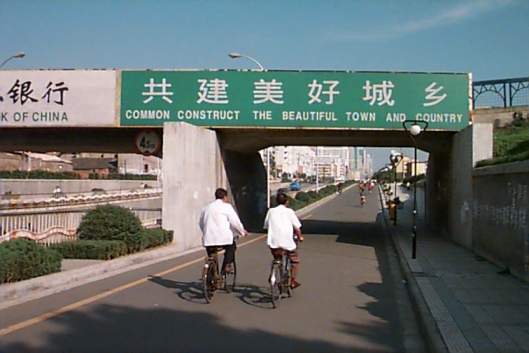
Entering Ningbo
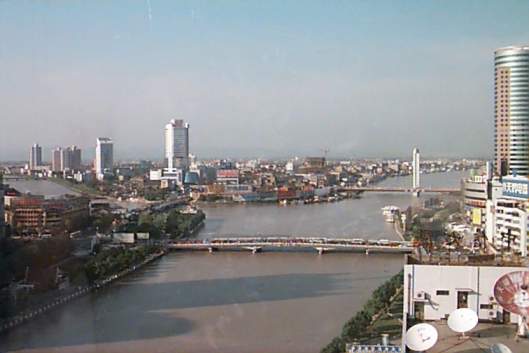
Ningbo's three rivers |
9 October, Yuyao to Ningbo,
53km (a) Knowing that Ningbo was only a short pedal away, we dawdled this morning --sleeping in, hanging out with the hilarious Randy in his office, yogaing in our spacious room. I don’t think we hit the road until almost noon. What we hadn’t anticipated was the headwind from hell, which made the 50k seem more like ninety. Following Randy’s advice, we took the old road to Ningbo, which runs roughly parallel to the new superhighway through peaceful foothills. For such a developed factory-infested area it’s amazingly pretty, full of tea plantations, bamboo forests and the inevitable expanses of ripe-looking rice. While the wind made for slow going, there was plenty to look at, and before too long we could make out Ningbo’s skyline in the distance. Ningbo is China’s second largest port and the richest-looking place we’ve seen in this country. Riding into town on a gargantuan avenue, we joined a floodtide of local cyclists. The feeling of camaraderie recharged us, but the huge weaving mass of pedalers made it difficult to get our bearings. A foreign devil we saw in the street (it’s impossible for anyone of our race to pass incognito in this part of the world; we stand out like sore thumbs even in the biggest cities) directed us to the Citic Hotel, which Randy had recommended. The hotel’s Chinese manager introduced himself as Fred and said he considered Randy one of his closest friends. While Fred was very welcoming and polite, it was clear that our bikes and generally dirty appearance made him a little nervous. For the first time of this entire journey, we were ushered in through the back door so none of the other guests would see us. Thanks to Randy’s influence, Fred gave us a room with a fantastic view of the confluence of the three rivers that marks Ningbo’s epicenter. Coming into town we had noticed a McDonald’s (the first we’ve seen in the PRC outside Shenzhen) and couldn’t resist the temptation of a sanatized dose of Americana. Two Big Macs later we were walking toward the ferry terminal, across bridges, through old neighborhoods of distinctive wooden houses and past a crumbling old Catholic church. The woman at the ticket counter couldn’t have been more helpful. She patiently answered all my badly-phrased questions and barked at people trying to elbow their way in front of us. The fast boat to Putuoshan island, we learned, didn’t take bikes, so we’d have to come back to Ningbo to pick up an overnight boat to Shanghai. We bought tickets for the following morning (one-way only, as return tickets are mysteriously unavailable) and continued our exploration of this appealing city. The Peking duck pizza we both ordered for dinner was delicious but overly filling. I went out to walk it off and stumbled immediately upon Ningbo’s premier homo gathering place –a riverside promenade just across from our hotel. I was beckoned by a whole group of my Chinese sisters sitting under an ugly concrete gazebo. They forced me to tell my whole story before I could ask any questions of my own. The most gregarious and open of the bunch was a large, fortyish man called Ling. He didn’t seem inhibited or closeted at all, openly stroking and kissing his much younger friend like a pet kitten. Ningbo, I learned, has nothing like a gay bar, and this park is where all the homos gather. To my untrained Western eyes, it looked much more like a social gathering than a pick-up scene. "Do Chinese gay boys actually have sex?" I asked, receiving the answer I’ve suspected for a while now: "Not very often." We hadn’t been talking long when whistles started blowing, indicating the closure of the park. Everyone obediently filed out and hopped on their bikes to ride home. It was only ten-thirty and the streets were already completely dead. I guess Ningbo’s nightlife –unlike its skyline—has yet to be developed. Shanghai, I had been assured, was where it all happened. |
| 10 September, Putuoshan (f) Cycling around for so long we’ve become accustomed to a certain amount of independence. There is an incredible free feeling of being able to get on your bike, set out for a destination, stop and photograph what you want, speak to whomever you like, choose your own hotel, eat wherever and whenever you want. To some extent that has poisoned us. Andy’s argument is that we have become worse and worse tourists. Our patience with semi-competent guides, itineraries not our own and crowds of feeble amateur travellers doing a weekend has fallen faster than the stock market. Everyone we’d talked to had raved about Putuoshan, one of the nine holy mountains of China. People from all over the country make a pilgrimage there. Even our guidebook gushed about it as the one place you’d possibly see the cliché "boy on a water buffalo playing a flute". We were excited about the possibility of going there with our bikes and then on to Shanghai to meet our friends and Andy’s dad. Our frustrations started early: the boat would not take our bikes. That meant we’d have to leave them in Ningbo, boat there, back and then, finally, on to Shanghai. That sounded like a logistical nightmare to me, but for the possibility of seeing this tranquil island I was game. At the ticket office of the boat we had our first drama. It was just like a Chinese train station, with people dashing up to the queue, bludgeoning everyone in line with their elbows and stepping up to the front of the line over their injured bodies. We’d developed a system to deal with their methods. I block the path of the merciless queue jumpers while Andy wheedles his way to the front. If someone brave gets by me we both turn on the bugger and threaten with great bodily harm. In this case we got Andy to the front of the line without having to do more than elbow and shove the impatient ones. There was no need to break any bones. Though after a few moments of this adrenaline was pumping through my veins. If anyone said so much as "boo" to me I’d have snapped his or her neck like a chicken. (or so I imagined) At the front of the line we encountered a hormonally challenged commie babe who would have nothing to do with us, so we had the opportunity to use our method in yet another line. This time rumor of our brutality had preceded us and we had no major incidents. At the front this time we met a charming and helpful agent, however other obstacles made themselves known. Two "helpers" decided that Andy’s Chinese wasn’t good enough and they hit us from each side taking so loud we couldn’t hear the clerk through her hygeniphone. (Why do they use this system of speakers and microphones in train stations and other public places? I’ve never seen one that worked properly and even in English they render the clerk unintelligible. Does anyone remember the show "Get Smart" and the cone of silence?) Finally the clerk dismissed our friends stating that "he (referring to Andy) speaks better Chinese than you, so go away!" We knew that we’d found a trusted ally. In a few seconds we held tickets for the next day’s boat, but mysteriously could not buy return tickets except on the island. That fact made me nervous…. Going without our bikes meant leaving nearly all of our gear behind. It was a fantastic feeling to be travelling so lightly. We walked to the passenger terminal with just a small bag each. Unfortunately the boat did not leave directly from the city; instead we were obliged to take a boring and long bus ride to a port closer to the ocean. The bus was a dirty old spring and shockless old wreck that bounced violently at each bump. In the back of the bus my knees were wracked violently against the back of the seat in front of me constantly. Poor Andy was wedged in between me and a Chinese girl and looked a little claustrophobic. Tranquil is not how I’d describe our fellow passengers. Upon reaching the dock we saw the usual boarding bedlam behavior. Folks pushed one another out of the way with their elbows and clunked one another with their baggage. It seemed a little surprising especially when we realized that there was reserved seating on board our rusting old hydrofoil. The boat itself was of the oldest variety. Surprisingly the rusting old bucket of a boat buzzed us to Putoshan without treating us to a new version of the Titanic or the Poseidon Adventure. Our arrival in Putoshan coincided with that of a massive ship full of weekenders and we fought our way on the long path from the dock to the shore together. Though on their vacation and at their destination they still fought and pushed for position in the line. Even before we left the dock there was a bad sign. Just to leave the dock and enter the island proper we had to pay a 40 kuai per person fee. I was already feeling captive, doubly so without return tickets. To allay my fears of being trapped here we decided to get our return tickets right away before seeking our hotel. At the ticket counter we were informed that tickets could only be had on the day of service --so said a surly ticket seller, the cousin of our first ticket clerk on the shore. Another smiley one advised us similarly, but vowed to hold a few first class tickets for us for the midmorning boat. Relieved we went in search of housing. A tout in the form of a middle-aged rather round woman attached herself to us like a tick. She followed us into town on a hotel bus and watched our every move. She’d seen westerners here before and knew we’d be begging her for her services at any moment. The first hotel we chose was a miserable tourist trap with but a few stars, still it asked over 700 agoutis for a room! There was no way we were going to pay nearly one hundred dollars for a dump. So we dutifully followed the tout to a few places. It was a busy weekend so all that was left in the less expensive hotels she took us to were basement rooms with bare cement floors and attic rooms with no headroom. Still, for these dumps they were asking nearly what we’d paid for rooms in brand new four star hotels. We dismissed her with a 10 kuai "tip" and set off on our own. We found a charming little hotel in the center of the town, whose frontage looked like a monastery with modern rooms behind. There we saw a great room and negotiated a deal. When we were ready to hand over the money the price suddenly jumped 25 percent. With great theater we stormed out and went back to another less charming and less expensive one. By this time I felt ripped off and hated Putoshan and was becoming more bitter and critical by the moment. It didn’t help that at any moment it might rain. I was sure there must be something to this island if so many people were visiting it so we vowed to put aside our initial impressions and walk around to see the sights. We walked down the road to a beach that had been characterized as scenic. We were stopped as we began to enter and asked for an entry fee of another 30 kwai. Every time we walked anywhere near something of touristic interest some babe in a uniform appeared and directed us towards a ticket booth. It was actually remarkable that we got anywhere on the island at all. Walking down the road minibusses buzzed by us at freeway speeds honking their horns. "Peaceful" and "tranquil"? My pretty pink butt! This place was an unfathomable hellhole. I wanted to leave them not in a box after having been run over by a psychopathic bus driver with empty pockets from the serial rip-offs. O.K. we’d made a few mistakes. Maybe we should not have come on the weekend. Perhaps we should have paid more attention to the warning in the guide that said there was risk of this place becoming over touristed. And, we did have a few fun moments. We met a couple of monks that were remarkably calm and told us which temples to visit. The temples were fantastic with great images of Buddha, huge trees and throngs of Chinese making offerings. At one we learned what tourism was all about for these pilgrims. Behind glass at one of the temples was a massive reclining Buddha. At his feet there was a little door with an attendant monk. Chinese men of all ages would line up, slip the monk some cash, produce a huge wad of hundred kuai notes from their pockets, lift the robes that covered the Buddha’s feet, rub their money on the Buddha’s soles and depart with their money in their pocket, "for lucky." The next day we were on the first boat out. Is it our impatience with tourist venues? Or, was this an especially heinous one? |
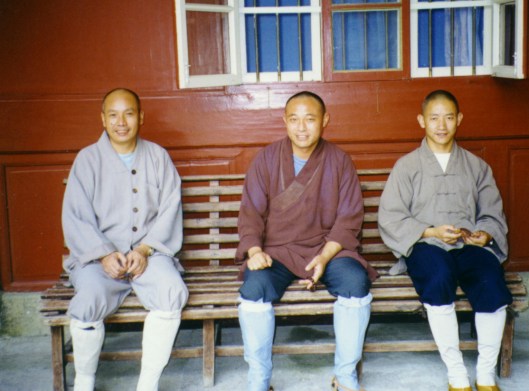 Chillin' in Putuoshan
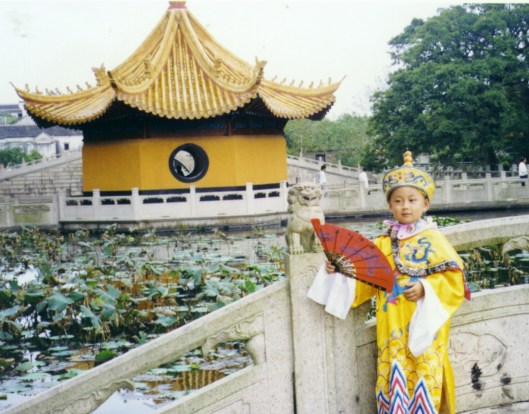
One of China's many "little emperors" |
© 1997 Frederick Felman and Andrew Broan, All rights reserved. No part of this web site may be reproduced in any form or by any electronic or mechanical means without permission in writing from authors or their agents.