This is the year of the tiger, I was born during a year of the tiger and I was bound and determined to see a tiger on my birthday. The safaris we'd taken so far had been great, we'd seen tigers at a distance, hundreds of deer, wild boar, peacocks and tens of other species. Our trips through the park had a "Raiders of the Lost Ark" feel to them as we motored through the jungle past stone structures being engulfed by vines, misty ponds full of crocodiles. We'd yet to see a tiger up close. At 5:30 in the morning of my birthday my happy dreams of frolicking with big teddy-bear like tigers ended with the buzz of the door of our hotel.
Our breakfast and coffee had arrived a half hour earlier than we'd agreed. Like clockwork Rasheed our guide arrived and we were bouncing down the road in the tiny open jeep to view the tigers. This morning the park had the same quality that it had in my dreams due to the thick cloudy mist. I shivered as the wind buffeted me. We entered the reserve and Rasheed came alive. His small black eyes shifted rapidly from side to side as he surveyed the underbrush for our visual prey. Six other jeeps and two open top busses were engaged in the same pursuit.
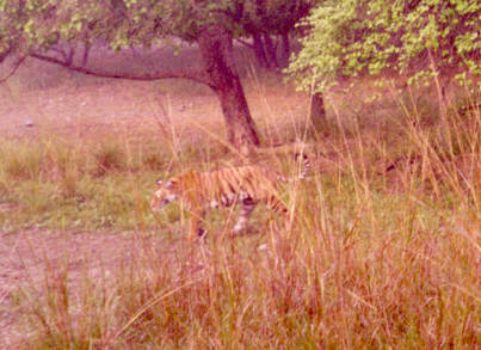
Just as the day before as we crossed the others we'd stop and the drivers would chatter at one another in Hindi (or was it Rajasthani) the conversation unintelligible to me except when they'd say "sighting" or "tiger". After only a few minutes in the park we found the trail of our tiger. Fresh paw prints in the dusty road told us he or she had passed just a few moments before us. To my surprise we came upon her in just a few moments. Rasheed explained that they like to walk down the road because it is easier than going through the brush.
Two other jeeps were already there and the *canters* (open top four wheel drive busses) were just behind us. No one paid any attention to the sign that stated "If two vehicles are at a sighting the third must move on". Like a house cat awakening from a nap, the huge beast extended its paws, stretched and walked just a few feet from the jeep in front of us. I wondered if it thought that the enormous British woman in the jeep in front of us looked tasty or not? As it passed a tree it lifted its tail and shot a burst of spray, marking its territory before sauntering down the road.
Surprisingly it seemed oblivious to the presence of the six vehicle parade behind it. When it reached the T-intersection at the end of the road it continued off into the forest without looking back disappearing into the mist and the thicket as carelessly as it had appeared. As we searched for more wildlife I started to think about the tigers' eating habits. They each eat two spotted deer or one sambar a week. There are 27 tigers in the park and they each hunt only for themselves, not sharing their kill with any other tiger. They can eat up to 25 kilograms of flesh per meal.
(the population of tigers in the park eat 2100 animals a year) I wondered why they don't eat us? There we are sitting in an open jeep a few yards from their razor sharp teeth and powerful paws. When we returned to the hotel I was happy, I'd seen my birthday tiger and was ready to celebrate the year. The following day couldn't have been a day of greater contrasts. The squalid and fetid train ride to Kota framed by elegant meals in over decorated dining rooms. Though, other than the service, we were the only humans at breakfast, I felt we were being watched.

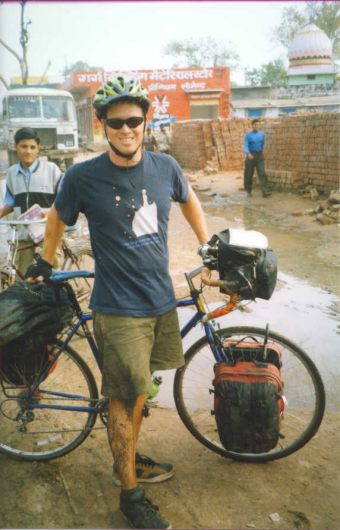
Making friends on the road
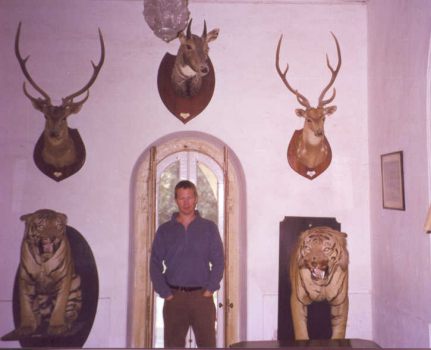
Perhaps it was the forty plus glass eyes of the hunting trophies staring blankly at us. I wondered if they might break into song or start a conversation like those in the Disney attraction, "Country Bear Jamboree". Tiger and leopard motifs prevail in the dining room of the Taj Hotel in Sawai Madhopur. The rooms' carpets, napkins, tablecloths and picture frames all carried the pattern of pelts. After breaky we were off to the train to Kota. Though off the bikes for two days my butt could hardly bear another day of the beating that the Rajasthani roads had dished out.
All the intelligence about the 130 km to Kota told us that it was more of the same. We were promised by all that the road after that was exquisite. I preferred the idea of taking a jeep, but Andy was insistent on the train. He thought it would be more comfortable, faster and ten-fold cheaper. He was right about the "cheaper" part. In fact, the fare was less than a dollar each and another for each of the bikes. Getting information about trains and how to put the bikes on it would prove more complicated than any border crossing. Matters were further confused by a derailment of the Delhi-Bombay train that shared the tracks with ours.
Finally, with everything arranged we went out to the platform to wait for our train. We were about to board when we noticed that our bikes were sitting on the platform and not loaded onto the train. Stepping off we argued that they should be loaded only to be refused. I suspect that we were too slow to baksheesh the porters and conductor. Good fortune shone upon us, sort of, because a local (read: so slow you can't believe you're not walking) train arrived shortly thereafter taking us and our bikes honoring our (more expensive) express train tickets. After boarding we found a place on the same car as our bikes.
No seats but there were primitive bunk berths mounted in the open car. We found a lower and installed ourselves much to the dismay of the peasants we evicted. They moved to the opposite bunk, faced us and watched us like an in-flight movie for the next three hours. The car was filthy, it may never have been cleaned and smelled like it might have been used to haul goats to market the night before. We passed the next three hours reading, writing and playing cards. Somewhere along the line I bonded with our peasant neighbors by sharing my throat lozenges with them.
They reciprocated offering peanuts, snacks and cigarettes. When we finally arrived we found that there were no baggage handlers to open the car and give us our bikes. Andy went to seek help while I remained with the car. It was a ridiculous game of hide the bikes for the next half-hour. I had to follow the car around the station like a lost lamb as they towed it around to-and-fro seemingly without reason worried all the time it might be spirited off to another station. Andy got more and more frustrated and vocal as we spent an hour trying to find our bikes.
Finally I found them again across the station. They'd been unloaded and were in the process of entertaining a crowd of travelers and station workers. We entertained them further as we assembled our gear and attached it to the bikes before departing the station hastily. More in keeping with our morning, we arrived at the stately palace of Kota on the banks of the river. Sadly the proprietors would only take cash for the room which left us severely short of currency in the middle of a weekend. We did have enough to go to the saddest museum on earth. Its only exhibit of interest was the armory filled with ferocious looking knives, daggers and swords.
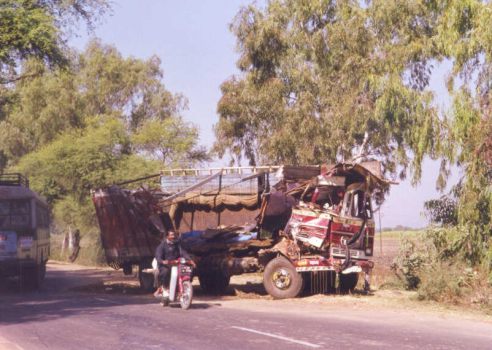
An all too common sight on Indian highways
On top of being a bad museum with crumbling exhibits it was prohibitively expensive, especially with our cash constraints. At over a dollar it was the worst tourist value in India. Most sites in this country are free or cost only pennies. More depressing was the obvious fact that the workers at the museum seemed to be very badly off. Some of them begged for cash as we walked the halls. Heading back to the hotel we rode our bikes through the center of Kota. Its narrow streets were flooded with humanity on all forms of transportation and more bovine hazards than we'd seen anywhere.
A few weeks before I wouldn't have dared pedaled my bike, laden or not, through the dense pack of people and cows. Cyclists, scooters, *autorickshaws* (three-wheeled taxis based on scooter drive trains, like small *tuk-tuks*) flowed like water in a stream past bustling shops many selling jewelry and cloth. We began to wonder what portion of disposable income is spent on women's clothing and bangles. We spent an hour trying to find someone who'd exchange some Yankee dollars for Indian rupees to no avail. It was surprising that no one would, since it hadn't been a problem before. We had no luck whatsoever except, by some miracle, the hotel extended us credit at dinner.
The dining room and living room of the palace looked as though the family still lived there, though we knew that they'd retreated to the upper floors. Replete with photographs, memorabilia and hunting trophies one wondered if time had stopped. One photo depicted the maharaja with a dead tiger. In his hand written below he bragged that this was "his 82^nd^ kill on foot." I was curious whether it was 82 *a pied* or 82 tigers total? It was hard to guess considering the seemingly endless number of trophies on the walls, stuffed and freestanding, rugs, pelts and other animal products in the palace.
The Prince of Kota made an appearance at dinner. Dressed in aubergine silk pajamas he greeted us. He'd studied at Brown and Columbia and was very well spoken. I was curious how he dealt with the poverty of his people. The next morning the prince was absent, though one of our fellow guests appeared. Mitch Crites was the first to arrive. An American, he'd been in India for over 30 years. Here he'd married a Persian woman and converted to Islam. Mitch had taken his academic background in Indology and Archeology and converted it to commercial use. Mitch had revived the crafts of stone inlay, calligraphy and stone carving of the Moghul emperors.
Currently he is engaged in building the new national mosque of Malaysia. Besides being a fascinating breakfast companion Mitch saved us that morning. At breakfast the hotel staff became more and more insistent that we settle our bill with cash at that moment. Two young men in pseudo military garb stood over us demanding payment even though I'd explained that we would need to go to the bank or another hotel to exchange that morning before leaving. Mitch came to the rescue; he was flush with cash, knew the value of a dollar and was willing to help. After our embarrassing situation was averted Mitch's friends arrived at the table.
Howard and Jane proved to be good company as well. Howard had the appearance of a gentleman archeologist which he apparently was. Mitch and he had met some thirty years before on a dig. After sharing our impressions of India we set off for Bundi and bid adieu to our new friends amid promises of keeping in touch. As we pedaled off the prince made one last appearance and pitched his website. Finally we hit the fantastically smooth road to Bundi. On the road we passed more bicycles than any other traffic. The most annoying traffic, as usual, was the motorcycle and scooter traffic.

Making friends on the road An all too common sight on Indian highways Bundi's palace
Not because we were fighting for the road, but because of the method of passing. Each comes up beside us, stares, pulls ahead, realizes that we are weird, drop back next to us and begin to question us. Where are you from, what is your name....? And on, and on.... Not that I don't appreciate their friendliness; It is just inappropriate on a motorcycle. First, it is hard to hear them. Second, it is dangerous because they are such terrible drivers. Third, their mounts are noisy and stinky. And last, the passing traffic honks insistently behind us when they ride next to us.
It just makes the riding experience entirely unpleasant and unsafe. Speaking of unsafe the roads are pretty bad if you don't understand the rules. Once you do there is little danger. The big and important rule is that you yield to anything bigger than you. If you have any question whatsoever about your safety get off the road. And we do; twenty, thirty, sometimes fifty times a day we ride onto the shoulder (or into the ditch) to avoid oncoming traffic. Those who don't pay the price. Every day we see the remnants of cocky behavior, usually in the form of a pair of trucks or busses that crashed head-on.
The grisly remains of the vehicles, usually bent, burnt and busted, are often splattered with the blood of the victims. The hulks sit on the roads for days after the events with guards protecting the contents of the trucks and the salvageable parts of the vehicles. Today we saw an especially gruesome one and stopped to try to figure how it had happened. Upon arriving in the ultra quaint town of Bundi we found lodging in the upper part of the town near the ancient and now deserted palaces. The three hundred year-old *haveli* was filled with charming little rooms decorated like traditional Indian homes.
Howard, Jane and Mitch had recommended that we find a guide named JP who had led them through the palaces and somehow had access to the locked regions that included frescoes that were 500 years old. We found him outside of our hotel and arranged a hike after our lunch. Our hotel proprietors did not like the young man and counseled us not to use him. He'd extracted money from some other tourists in some scam that was too complicated to understand. I kept on my guard after the warning but we still decided to use him. It turned out to be a great hike and his services were super helpful despite our hotelier's concern.
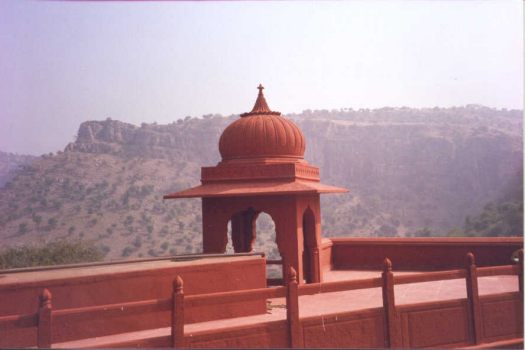
The hillside palace and fort looks down on the hilly medieval looking town. We were awed by the view and the beauty of the surrounding terrain. After a feast of a meal we started on a nighttime walk around the town. It was the most charming of all the cities we'd been in so far. Elections were about to be conducted in Rajasthan and the town was abuzz with pre-election activity. The most common promotion of candidates were vehicles with huge speakers attached playing audio taped slogans, sales pitches, songs and speeches. I was glad that all of this was to end then next day as polling was to begin.
I felt a subtle shift in my appreciation of India this day. Was I beginning to like it?