Portsmouth to Lewes
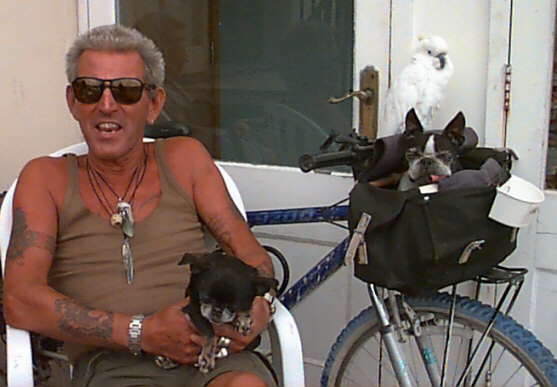
Tattooed Spike, Tish, Teabag and their feathered friend Sam
Whether it’s by plane, boat or train, my arrival in England is always met with the same impression: what a dreary and shabby place this is. Even under blue skies –as was the case as we pedaled into Portsmouth—there is an overwhelming sense of grayness. Square brick buildings covered in soot, the 1930’s aesthetic of the storefronts, and the ashen complexions and expressions of the people —all contribute to the feeling of being in a world with all the color sucked out of it. It almost looks as if they’re still digging out of the aftermath of the Blitz. Could this bleak and depressing place really have been the center of a vast empire?
The nine-hour boat ride had passed without incident. The channel was smooth as glass, so I didn’t get to see Fred change colors and barf. We spent most of the time napping in our cabin and wandering around the deserted decks, staring off into the fog. Once in Portsmouth, our mission was to find a place to spend the night. The sun was hanging low in the sky, and we didn’t want to get caught in the dark. Of course, it would remain light for another four hours at this Northern latitude, but the sense of urgency was heightened by continuing problems with my front tire.
Now that we were in an English-speaking country, it was Fred’s job to take care of the negotiations involved in securing lodging. It wasn’t easy for him though, since all the hotels we stopped at were either full or bicycle-intolerant. I felt frustrated being on such an unattractive, unfriendly island full of linguistically and orthographically challenged people, who spell color with a “u” and pronounce “whining” “win-jing.” After three or four unsuccessful attempts at securing lodgings, I began whinging “where’s the motel?” Even though the day had been anything but athletically challenging, I was tired of stopping every ten minutes for a bout of sisyphean pumping, and wanted nothing so much as to roll my bike into a ground floor room at the nearest Ramada Inn, soak in a hot bath and lose my brain to 125 channels of cable t.v. The receptionist at one fully-booked hotel called around and found us a room in a bed-‘n’-breakfast sorta place in the suburbs. To get there we rode along a seaside promenade which had clearly enjoyed its heyday during the reign of Victoria Regina (say that six times fast). Of course we had to unload our bikes completely and lug everything up a narrow staircase under the disapproving eyes of the hotel’s owner to our little room full of beds and tea-making apparatus.
Once settled in, we struck off in search of a meal. Our perpetually unreliable Spartacus Guide led us to a non-existent homo café at the intersection of Albert Road and Victoria Road. Nearby, however, we found a pub full of people eating and we ventured in only to learn they were no longer serving; would we like a beer? I was beginning to suspect that Portsmouth had been engineered to alienate American cycle tourists. These suspicions were confirmed when we found that the only place serving food after nine p.m. in Portsmouth was… a carry-out fish and chips shack. Back in our room, Fred somehow managed to polish off his cod, but I couldn’t face my haddock, and threw it in the trash can, feeling perversely satisfied that we’d leave our overpriced and unfriendly accommodations smelling of fish and old grease.
As the reader might have surmised by now, neither Fred nor I are rabid anglophiles. But the morning nearly converted us, when we made our way downstairs to indulge in the second feature offered by our bed ‘n’ breakfast. The huge helpings of eggs, sausages, tomatoes, mushrooms, cereals, fruit and pastries came as a welcome change from the sparse continental breakfasts we’d been enduring. For the first time in nearly a month, we felt properly fortified for a day of riding.
Before we could set off, however, I had my flat tire to tend to. The Portsmouth Cycle Exchange is located at the now-familiar intersection of Victoria and Albert Roads, and is well worth the detour if you ever get the chance. A skinny, geeky-looking guy called Derek gave me heaps of sage advice on wheel repair. Of course, I only understood about a quarter of what he said. His waxy gnome-like co-worker spoke more clearly, though, and told me how much he loved Americans, finding them gracious and optimistic. I told him I liked Americans, too, yet withheld comment when he began to complain about people studying “useless” things like art and literature in school.
Next on our list of tasks was to find a map. This was accomplished in the “precinct” (Britannic for pedestrian mall), where Fred was accosted by an unfriendly old Brit in a linen suit while I was inside a bookshop. The man apparently came up to him complaining that Fred was taking his usual place on a park bench. As we pedaled off a couple of minutes later, he shouted after us, “No cycling allowed!”, to which we responded by waving and smiling.
Getting out of Portsmouth was a total nightmare. The only highway out of town was solid with speeding metal death canisters, all driving on the wrong side of the road. A sorry excuse for a bike path ran intermittently alongside it, its surface no longer suitable for riding –a legacy of the endless Thatcherism that has strangled the life out of this little island country? My panniers being brushed by the uninterrupted stream of automobiles, I hoped that the new Blair administration would have more cycle-friendly policies.
Making matters worse was the wind, perhaps the strongest we’ve encountered on the trip. It was coming straight out of the East (the direction we were headed, bien sûr) and gusted up to forty miles an hour. That’s what the weather report said anyway, and we didn’t doubt it once we were out in the countryside, pedaling with all our might down hills. The countryside looked green and attractive –as the English countryside is meant to—but even on the secondary roads, the traffic continued to be a menace, so all our concentration was focused on staying alive in the leftmost part of the road.
Our goal for lunch was Chichester, which looked close on the map. But with the wind and our frustration with the drivers, we were exhausted by the time we stopped there for a lunch of a salad with “brown sauce” and a stuffed potato. We decided to take the train to Brighton, only a few miles from Susannah’s house in Lewes and the supposed gay capital of Britain. The train was filled with noisy packs of schoolchildren in uniform. Many of them had bicycles, too, and we liked how accommodating the rail system was to cyclists –much more so than the roads, anyway.
Brighton is a big town, we discovered quickly, and an irritatingly hilly one. Of course all the traffic moved along at unbelievable speeds, putting our lives in jeopardy, but I insisted we check out the beach and sample the queer scene there. We stopped at an outdoor café on a traffic-clogged cliff, where we met an avid cyclist called Spike, who used his bike not only as a means of conveyance but also as a sort of mobile petting zoo. He carried two small dogs –Tish and Teabag—in his handlebar bag, while his cockatoo (Sam) used the bars as a perch.
We thought we’d take the scenic route to Lewes, but wimped out yet again, ostensibly due to the increasingly threatening skies. The main road was a horror, but had a mostly usable bike lane running alongside it. It went up and over a series of steep bald hills called “downs” –one of those very specific Britannic geographical features, like heath and weald and moor. Lewes itself was predictably traffic-clogged, but otherwise adorable. It didn’t take us long to find Susannah and Jonathan’s little house, where we caught up on each other’s lives over tea and scones.