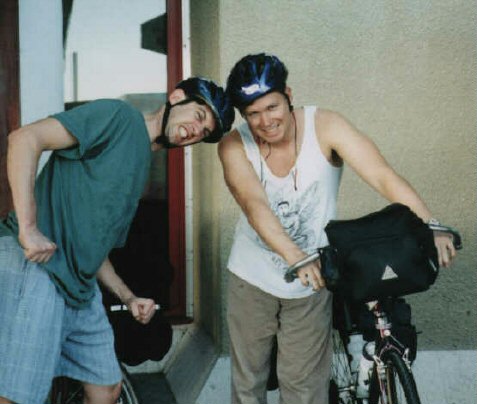
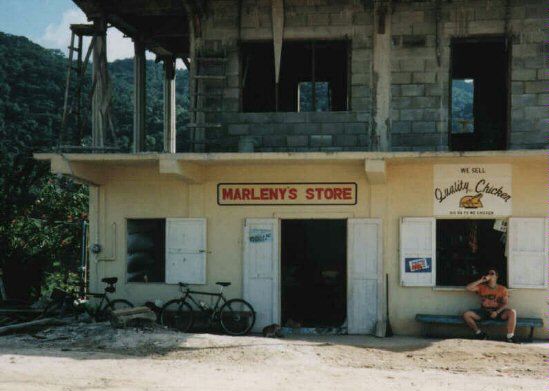
We arose at around 5:30 and watched the sun rise from the sidewalk tamale stand where we had a breakfast nearly as delicious as the beautiful mexiboy sitting next to us. It struck us once again how truly multicultural Belize is as other customers included blacks and Chinese, eating food prepared by a Mexican woman. An East Indian dude was also at hand, eager to change our dollars into pesos, while severe-looking Menonites glared at us disapprovingly from across the street. Our second and last day cycling in Belize was far more interesting than the first, mostly because there was lots more to look at, and the rolling terrain kept our fingers busy shifting gears.
About ten miles out of Orange Walk we turned onto a dirt road, an alternate route to Corozal and the border beyond, one that promised less traffic. It was a poorly maintained dirt road, yet faster riding than the highway due to its relative smoothness. The local monoculture of sugarcane became quickly apparent and supplied some shade from the surprisingly intense early morning sunshine. Two more surprises awaited us outside the sleepy town of Libertad, where we stopped for drinks and snacks: a swank-looking hotel (named \"Santa Cruz\") in the middle of nowhere, and a guy on a bike (practically the first we'd seen in Belize) holding a baby bird.
We noticed that the transition to Mexico happened well before the border; no one was speaking English anymore, and the dominant feature of every village on the paved road from Libertad to Corozal was the local tortilla factory. We followed the beach route into Corozal and stopped at the first palapa we saw for a session of postcarding. It was too early for lunch, but too hot to be in the sun. An odd pair of locals soon joined us out of curiosity: Stafford and Laura. They worked together as seamstresses nearby. Stafford was the queeniest little teenager we had met in some time, and we wondered whether he realized yet that he was queer.
I got him to sew up my blown-out handlebar bag, and then Laura's little brother led us to the post office to mail off the last of our cards. Lunch was in a place recommended by our seamstress friends, a place run by an American (God knows what he was doing in this godforsaken place), with good food and a breezy balcony perfect for backgammon. At 2:30 or so we reluctantly hit the road under a blazing sun. Soon we found ourselves at the border, where we encountered the expected bureaucratic dance of papers and rubber stamps. A customs officer told us that Bacalar, our destination, was 32 kilometers away, which sounded a lot easier than it actually was .
The sun had drained me of all my energy, and it was tough going once we hit the main Westward highway out of Chetumal. The overall first impression of Mexico was how orderly it was, and the undeniable fact that we were in a large country with a mammoth infrastructure, evidenced in the \"glorieta\" at some 10km from the border --an enormous traffic circle surrounding a gargantuan chunk o' public sculpture. The second new word du jour was \"topes\" --speed bumps---which comprise an integral part of Mexican highway culture. Every village is heralded by several sets of topes designed to slow down the traffic, and the topes themselves are announced with far greater elaboration than the actual village.
The first sign coming into a Mexican village warns: \"TOPES 300metros\", followed by international-style icons of topes, then: \"TOPES 200 metros,\" etc. The inevitable sign \"PUEBLADO PROXIMO:\" followed by the name of the village and the number of its inhabitants, gets lost in all the semiotic noise over topes. After several days of riding over topes, we came to refer to the more characterless villages we passed through as \"Topetowns.\" When we turned northwards off the main highway, the truck traffic thinned out considerably and the jungle all but swallowed the road, thereby providing us with some much-needed shade. Signs announcing Bacalar and its topes were met with relief, especially with the sun so low in the sky.
After ten days in Belize, we had learned how quickly it gets dark in this part of the world. Fred started whining a bit about wanting to stay in the advertised hotel (which we hadn\'t expected) but I had already made up my mind that we ought to be trying camping. And the campsite was right there and looking mighty inviting. Besides, it was only 15 pesos, less than two bucks. We could spend all our money on food at the turista-type restaurant next door \--which is precisely what we did. After setting up camp and washing the road gunk off our bodies, we scored a table beside the cenote --a round Yucatecan sinkhole in which people swim---and watched the sky turn colors as we drank our first Mexican beers of the trip.
It felt pretty good, and I felt happy knowing that this was our first-ever night of self-supported cyclo-camping. We struck up conversations with some of the people around us: a French-Brit hetero couple living in Berlin with their high-strung daughter; and a middle-aged American professor from Davis living in Cancun who touts duckweed as a solution to sewage problems in the developing world. The seafood brochettes were delicious, but the waiter brazenly tried to rip us off, rounding the bill up from 135 pesos to an even 200. Perhaps he could tell it was our first day in Mexico. I'm still upset that Fred tipped him...
It was raining when we woke up in Oxkutzcab, so we mayabed the remaining 100 kilometers into Merida, where we wasted no time getting hooked into the local queer scene (it cost me 4 backgammon units to get Fred to approach a smiley boy called Leonel who worked in a neighboring hotel) and overfamiliarize ourselves with Wannabuyahammock square. Merida is a lovely city that came as a shock after the poverty and simplicity of the Yucatecan hinterland. Arriving into town, we passed through a huge industrial sector that looked transplanted from the USA. It didn't take long for us to see that the parts of town where people live and shop were also neatly divided into highly segregated districts.

Roving South Asian money changer finds a customer
The center of town, just North of the zocalo, is the tourist ghetto. Our hotel was at the epicenter of this, located on Wannabuyahammock square, filled with aggressive street salesmen. The hotel itself was a total score. Aptly named the Gran Hotel, it has a decidedly special turn-of the century glamour. The rooms are all arranged around two vast balconies surrounding a central courtyard a floor below. We scored with our room, too, which was a kind of suite: a bedroom with a perfect god-sized bed, and a funky old bathroom separating it from the room we referred to as the \"yoga room\"
--a large, mostly empty space furnished only with a sofa and possessing a balcony overlooking the city's main street, calle 60. Our time in Merida was spent accomplishing a variety of tasks attendant to long-term travel. Foremost among these was investigating the possibilities of flying from there to Havana, which turned out to be a more complicated process than we hoped, due to antediluvian technology, visa applications and the necessity of paying for everything in cash. Getting our laundry done proved equally frustrating, as did figuring out what Leonel was all about. Before taking us to what he claimed to be Merida's only queer bar on Saturday night, our sexy young host drove us up and down the flashy, Americanized Paseo Montejo, filled with upmarket restaurants and nightclubs, shopping malls, and drive-thru banks.
The gay bar was an enormous open-air cavern of a place near the industrial part of town. We arrived just in time for the drag show, which took place on a vast stage adorned with cardboard and Reynolds Wrap. It was pretty much what one would expect, and not much different than Norma Jean's in Castroville. Shivering in the cold air and dead tired, we practically had to beg Leonel to take us back to our hotel. Sunday is a big deal in Merida, at least in the touristic center, where they close the streets to traffic and set up stages everywhere for various cheesy musical acts.
We thought that this was what all the locals did on Sunday until we ventured South of the tourist ghetto into the market district, which was absolutely thronged with manic shoppers. Here we found the real Merida that Leonel hadn't shown us. The covered part of the market was a fascinating place reminiscent of the pasars of Java; it seemed like one could obtain anything there, from birds to spare tractor parts. I was especially interested in the tortilla factory and its amazing industrial-age equipment; Fred liked the jewelry section. After a while, though, the crowds became too much to take, so we elbowed our way back to our hotel sanctuary.
Later we walked up to the archeology museum, which was closed. To amuse ourselves, we invited Leonel back to our room, but once he got there he played an elaborate game of \"I can't believe that you have lured me up here for sex.\" So it was just the two of us for dinner on the balcony of a pre-fab romantic restaurante overlooking calle 60, followed by a cheesy American flick (\"The Fan\") and a fruitless junket to a nearby bar listed in the Spartacus guide. Monday I woke up with a severe bout of malaise that was most likely motivated by the oppressive muggy weather and having nothing clean to wear.
I felt trapped in Merida and wanted to get out. Fred helped me out of my funk, though, by insisting we walk once again up the Paseo Montejo, which the locals compare ad nauseum to the Champs Elysees. The museum was closed again, but a shopping mall catering to the middle classes was open. Fred got his hair shaved off while I waited in an endless line at a K-mart-like megastore to buy batteries for our walkman. The \"10 items or less\" aisle was a study in inefficiency. Just like everywhere else in Mexico, the cashier was unable to make change, and kept buzzing a collegue over to change a 20 into two 10's.
This same transaction took place with virtually every customer in the thirty-odd person line. I vowed I would never allow myself to feel vexed at Safeway again. We lunched at the Hyatt nearby --mediocre food and worse service in a glacial, deserted cavern of a \"bistro\"---before marching all the way back downtown to continue our ongoing dealings with travel arrangements and laundry. That evening Leonel surprised us by calling and setting up a late night date in a bar called Pancho's. When we arrived Leonel wasn't there, and after some table shuffling (Fred was understandably allergic to the cheesy band and its proximity) we gulped down some rather tasty 'ritas and alternately deconstructed the weirdness of Pancho's and hypothesized more on Leonel's mysterious motives.
Pancho's is almost identical aesthetically and experientially to a yuppie Mexican restaurant in suburban America. The waiters were all dressed like Pancho Villa, complete with silly sombreros and cartridge bandoliers, and the decor was funky in a studied, vanilla sort of way. After another drink, we hoped Leonel wouldn't show up so we could sleep, but just as we were walking out the door he came rushing in saying he had been waiting for us outside --typical, we figured, realizing we were stuck into another drink. But the margaritas had taken the edge off and Leonel seemed more bearable. When it was time to go, our Merida host suggested we get into his car.
We thought we'd just walk the block back to our hotel and turn in, but apparently Leonel had other ideas. \"Where do you want to go now?\" he asked. Fred moaned, but I was game: \"the Imperial Bar.\" Leonel pooh-poohed it as being for the lower classes, but I insisted, and we drove past to find it closed. It was here that Leonel surprised us, proving himself to be something other than the clueless, confused homo we had taken him for. He pulled a set of keys from his pocket and proposed we go to his friend's empty house. The casa in question was out in a new, flavorless suburb which reminded me again of Indonesia (my theory, which I'll try to develop more thoroughly some day, is that Mexico and Indonesia are the same country): a cookie cutter house on a cookie cutter street.

Andrew and his sewing circle in Corozal
The decor was minimal, but what there was, was of highly dubious taste. Leonel explained that the house belonged to a queer cousin (que familia!) who lived with his parents like any good unmarried Mexican boy, but kept this house for assignations. We didn't tarry long examining the decor, though. It would have been more fun had there not been so many mosquitos. The next day was devoted mostly to getting our asses to Cuba. It was one of those connective, logistical days that are essential in any long or complicated voyage. First we had to scrape together the cash for the travel agent in Leonel's hotel, which wasn't so easy since it surpassed our atm limit.
As expected, cash advances on our French visa cards took a while --but not as long as our search for bicycle boxes (there weren't any at the airport, reported our travel agent with an enervating smile). Under a nasty gray sky, breathing the poisonous, temperature-inverted air, we made our way through the throngs to a bike shop in the market area, where the only bike box they kept was for a child's model. \--So we opted for an oven box and a fridge box for an appliance store instead. Fred's job of confecting a suitable box for both of our bicycles from what looked like bits of cardboard was a sight to behold; Olivier would have been proud of what Fred dubbed \"Frankenbox.\"
The task was performed in the yoga room, and it took a serious while. I helped, mostly by fetching more tape and providing moral support. There were a couple of moments, though, when we'd look at each other hopelessly, thinking: what the hell are we doing? Are we totally nuts? But everything ended up working beautifully. When the time came to leave for the airport, I found a friendly and understanding taxi driver with a perfectly-sized rack on the top of his car. After checking in at the airport, a young and scruffy American guy stopped us and we talked to him for an hour or so.
His name is Fielder and he had biked from Merida to Tikal (taking the bus back) on a 25-year-old ten-speed, with no map, no water bottles, and no cycling gear whatsoever. We also met an older American dude from Sacramento who was on our flight and who was working on the construction of an American embassy-like building in Havana. It was his first time, there, too, but he was taking it in stride, obviously an old travel pro. Landing in Cuba went pretty much as expected. From the plane Havana looked almost totally dark; what lights there were were very low wattage.
The terminal was basically a Quonset hut, full of employees who didn't seem to be doing much. Fred found a friendly and helpful young woman who went to look to see if our bikes had arrived (there was no point in waiting if they hadn't). Amazingly, she came back with good news. The box looked bad but not terrible, and as we plunged out of customs into the Cuban night --miracle of miracles---the first taxi driver we encountered had a van! He wanted \$25 but we were hardly in a position to argue. We couldn't see much on the way into town, partly due to the general obscurity but mostly because of the driver's outrageously inappropriate speed.
What we did see was charming, though: a crumbling, elegant city that looks like a tropical East Berlin. Plus lots and lots of bicycles. All of the motorized vehicles --with the glaring exception of our van---were ancient, decrepit and moving at a snail's pace. We pulled to a screeching halt in front of the Hotel Presidente, where the first impression was aural rather than visual. A fantastic band was playing sexy mambo music on the terrace and another band was playing tired standards in the dingy lobby. The staff buzzed all around us, fascinated by our enormous, mysterious box and our odd accouterments.
We didn't dare open the abused box until we got into our decidedly unglamorous room. Another great surprise: they were intact. Fred was intent on assembling them right away under the 20-watt bulb. By that time it was past midnight and time to check out the music and the local beer. The former definitely outshone the latter, and the ambiance at the bar was creepy --desperate-looking, aggressive whores and a couple of drunken, jaded customers, presumably from Eastern Europe. We chose to enjoy our bad Cuban beer and awesome panini on the terrace, where the music stopped almost as soon as we got there, to replaced by the sound of crickets and the occasional 50's era car motor.
Two creepy dudes invited themselves to our table and went through the usual sleazebag routine, asking us how much I'd paid for my watch, commenting on our footwear, proposing \"nice black girls\" and finally a walk around the neighborhood (no thank you). It was Christmas eve. We went to bed eagerly anticipating Cuba by daylight, just like kids wondering what Santa had left under the tree.

"Who says Jews don't camp?" asks Fred