3

Havana to Las Terrazas

It was Christmas morning, and the first time this trip that we had slept past 6:30. We woke up just in time to watch the sun rise over the meeting of smog and sea that constitutes Havana. The ambiance (and the food) on the 10^th^ floor breakfast room was pure Eastern Bloc, but the view from the terrace was breathtaking and the coffee gloriously strong. On the ground floor I discovered a travel agent who called around for me. I had picked Soroa --70 kilometers west of Havana---as our place to spend the night, but she learned that it was closed, being used as a movie set.

After some thought (actually I think it was the car rental boy at the next desk who came up with it), she proposed the Hotel Moka in a \"Zona Turistica\" called Las Terrazas. She couldn't reserve us a room for some inexplicable Cuban reason, yet felt certain that there would be space and assured me that it was a fantastic spot. Given the gloomy surroundings of the lobby where we sat, I didn't expect much. Packing our bags in our room, I wondered about the sounds of schoolchildren across the street. Wasn't Christmas a holiday here? Apparently not. \"Every day is a working day,\"

a cheerless desk clerk explained to me later, with more than a touch of irony. I've learned since that Christmas was officially canceled as a holiday some time in the '70's. Pretty amazing when you consider that this country was virtually 100% Catholic before Castro came to power, and that even in Islamic Indonesia, Christmas is an official holiday. So we hit the road on a day like any other in Cuba. Billboards wished us a happy 1997, but there were no signs of Christmas anywhere. A Champs-Elysees- like boulevard led us to the Plaza de la Revolucion, where an enormous steel portrait of Che Guevara --the national saint---graced one monumental building.

Generosity pervades - rum toting friend

Generosity pervades - rum toting friend

All the clichés of Cuba surrounded us: decaying colonial grandeur, jury-rigged mass transit, the world's most antiquated auto fleet, communist slogans, and bicycles [everywhere]{.underline}. For several miles through town we kept apace of a funny-looking tractor pulling two tanks. The three drunken peasants aboard this vehicle kept trying to get us to stop and drink with them. Eventually we conciliated and let them fill one of my water bottles with rum --which is what their tanks (and bellies) were filled with. It was the first of many such encounters with what appears to be a national trait of boundless generosity. Shortly thereafter we hit the autopista, taking a cloverleaf ramp onto the most amazing road I've ever been on.

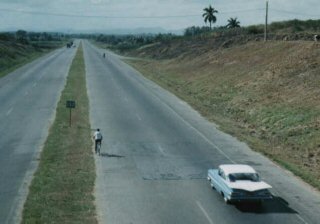
Instantly we were plunged into a hallucinatory experience, surrounded by every kind of vehicle imaginable, most of them confected from various bits of metal and wood and held together by wire. The whole aesthetic was eerily apocalyptic, but the pace was Caribbean sluggish. \"It's like 'Road Warrior' on Valium,\" I shouted to Fred over the din --a pretty astute first impression, it turns out. The autopista is a misnomer, since there are very few autos on it. Instead, it is six lanes of harmonious chaos. A sign explains that the right lane is reserved for bicycles, but we found it full of tractors, horse carts and pedestrians as well.

Myriad of Products

Myriad of Products

One poignant image we witnessed was a guy waving us down desperately to sell us his wedding ring from the roadside as we pedaled by. Other objects for sale included garlic, fruit, lettuce and livestock. The speed limit for the middle lane is 40km/h, 60km/h in the fast lane, and here you find all the vehicles from \"Road Warrior.\" The motorcycles all have sidecars and are loaded down with people and goods. The Cubans have taken the term \"multi-purpose vehicle\" to its (il)logical conclusion: semi trucks have been converted into buses, and 1950's Plymouths are stuffed with sugarcane. Many flatbed trucks have wooden shacks constructed upon them, to provide shade for passengers.

Nearly every motorized vehicle also had bicycles attached to it --even the gas trucks. On the buses, the bikes are hung out the windows by their seats or handle bars. Not surprisingly, many vehicles of all sorts were stationary on the shoulder, broken down. Under every bridge were entire colonies of people looking to hitch a ride, and many of the prospective female passengers overtly used their sex appeal to get picked up. The air was all but unbreathable, choked with black exhaust in spite of the wind. About thirty kilometers out of Havana, though, the lanes decreased to four (plus a shoulder) and the traffic volume dwindled to practically nothing.

In the countryside, we were quick to discover, the bicycle is the undisputed king of the road. Amazingly, we were able to ride abreast for the hundred-odd miles of autopista, a glorious tailwind blowing us the whole way. We could have made it all the way to Pinar del Rio city, given our average speed of 20 mph, but Fred wasn't feeling great, so we set our sights on the Hotel Moka. Along the way we stopped at all three roadside cafés we came across. At the first there were only two menu items: cookie-sized hamburgers and rum. We decided to push on, but before we did we were stopped by two Cuban cyclists totally decked out for sport cycling.

Transportation in Cuba

Transportation in Cuba

The more talkative of the two explained that they worked at a hotel in Havana and were on a training ride. As they pedaled back towards Havana against the wind, we pondered over how they were able to acquire such decadent merchandise. At the second \"cafe\" sandwiches were available, but not to us. It was commie weirdness that I didn't dare question. But then a black guy on a bike loaded down with oranges came by. We still had no local currency, and asked him timidly how many a Yankee dollar would buy. The answer: thirty or forty. I realized we wouldn't go hungry in Cuba, and was happy to learn that one could easily get 20 Cuban pesos for a buck.

Our dollar got us a dozen oranges and our first fifteen pesos (which we still hadn't exhausted six days later). The third café looked more elaborate, and it was. There was still the perplexing lack of food, but refrescos could be had --for dolares only, thank you. So Fred and I dug into the salty snacks purchased in Merida and sat down to a couple of hours of backgammon and chatting with the auto tourists who passed through. Patrick and his family were English and living in Luxembourg, and then there were the French, whom we soon found to be ubiquitous in Cuba.

Andrew and Enrique "after pedaling slowly uphill"

Andrew and Enrique "after pedaling slowly uphill"

Had we known the proximity and fabulousness of the Hotel Moka, we wouldn't have tarried there so long. A billboard announced the \"complejo turistico\" after less than a kilometer's pedal, where we turned off the autopista to climb some rather big hills before being greeted by the incomparable Doctora Maria de la Concepcion Perez-Eiriz at the reception desk. \"Yes,\" she announced cheerfully when I asked if there was a room for us. Quite an elegant room, too, with marble floors and a big terrace. I jumped into the bath with my welcome cocktail, and turned on CNN to listen to doings on Wall Street --it all seemed so surreal after the autopista experience.

Later we hung poolside for a bit of backgammon and prawn brochettes, followed by yoga on the terrace and a tasty dinner. Altogether a perfect first day in this mysterious, ceaselessly surprising country.

"Frankenbox" saves the day, Bikes safely packed for export to Mexico

"Frankenbox" saves the day, Bikes safely packed for export to Mexico

4

Las Terrazas to Vinales

After the previous day\'s experiences, we knowingly had the kitchen make us some sandwiches for the road. After some deliberation with Doctora Maria (winner: most elaborate hairdo in Cuba), we decided on the autopista route to Vinales. It was longer, but with far fewer hills. Besides, we liked the autopista for its halluciatory twist on the American Interstate network. Again we saw pigs being pulled in trailers behind motorcycles, bikes loaded down with sugarcane, fabulous fifties cars with bike racks chugging along at 30mph. And today there were bonus wonders: A whole series of unfinished bridges over the road; farmers drying their rice on the highway's shoulder; a farmer herding his goats in the median strip.

At kilometer 120, another tourist stand cropped up, far more elaborate than the previous one. We bought Che Guevara tee shirts and a map of Pinar del Rio province, and chatted with the two young, educated commies who manned the shop and spoke uncannily perfect English. Rather than going through Pinar del Rio town, we took a shortcut through Las Ovas. Instantly, the whole experience changed. We were now witnessing everyday rural Cuba rather than Cuba on the move. It was surprisingly, almost shockingly, clean. Tidy houses with immaculate gardens. Each house had a shaded terrace in front with at least two rocking chairs.

We stopped in front of one such house to check out the shrine to the Virgin standing on the lawn --the first evidence of religion we had seen in Cuba. The woman inside the house came out and started jabbering at us in nearly incomprehensible Spanish. She was old and obviously a card or two short of a full deck. Pulling out a wad of American dollars from her shirt pocket, she asked us if we would sell her our clothes. Considering the way we were dressed --and what we doubtless smelled like---we pronounced the woman mad and pedaled onward. Soon the road joined up with the main road to Vinales, whereupon we met with two young Cubans who were going there too.

Enrique pedaled alongside me the whole 17 kilometers up a seemingly endless (though mercifully graded) hill. His was the first multispeed (5 gears) bike we had seen in Cuba. He kept telling us we should pedal slower uphill in order to conserve energy. He took us right to the doorstep of Los Jazmines, a communist-style resort with a drop-dead view over the Vinales valley. Guzzling beer by the pool, we met two Brits who were also touring Cuba on bikes. We also met Anita, \"Public Relations Director\" of Los Jazmines, who seemed to fancy herself the activities coordinator on a cruise shop and epitomized the perky young communist.

Transportation in Cuba

Transportation in Cuba

She first urged us to join her on a hike up a mogote --the local name for the bizarre karst hills which make Vinales famous--- the following day, but later reneged when she learned she had to pick tobacco with the UJC (which I correctly guessed as standing for Union de Jovenes Comunistas). They were picking her up in a tractor at 7am, she said. Needless to say, it was an activity we chose to skip. Later we discovered the Brits to be correct in their assessment of the hotel's cuisine and service, both of which were awful --very Eastern European in style and flavor.

After drinks at the funky old bar and a round of badly played pool, with nearly 75 miles under our belts, we were ready for bed.

Andrew and Enrique "after pedaling slowly uphill"

Andrew and Enrique "after pedaling slowly uphill"

5

Around Vinales

It was a sticky heavy day in the Vinales valley, even in the wee hours. Fred and I did our usual thing of watching the sun rise --in this case, an awesome spectacle---and waiting for the restaurant to open for breakfast. Not surprisingly, breakfast was another service nightmare, taking forever to get a half cup of coffee from the bitchy waitress (named Trufina, we later learned). But it felt great to jump onto our unloaded bikes sans helmets for a day of aimless exploring. First we visited the tacky, bewildering Mural Prehistorico, which consists of limestone cliff painted in lurid colors, depicting snails, dinosaurs and cavemen.

We met a nerdy guy from Norway there who informed us of the stated penalty for Americans visiting Cuba: \$50,000 and up to ten years in prison. Oops! And we're going to publicize that we did this? Part of me wants to get into trouble and become a cause celebre, with every ACLU lawyer begging to represent us; but of course that could mess up our plans to spend the next two years on our bikes. We lunched in a beautiful old house in lovely Vinales town, la Casa de Don Tomas. Its menu stated its commitment to \"Cuban gastronomy,\" but on our plates we found the same canned vegetable medley they dished out everywhere else we'd been.

Fine food and communism don't mix, it seem; and the Casa de Don Tomas was a state-run enterprise, where the chef and waitress, and even the musicians, were government employees. The ambiance was great, though, and so was the view of the town's elegantly colonnaded main street, in which a constant stream of Chinese bicycles languidly passed by. Remounting our own trusty two-wheelers, we headed out towards the Cueva del Indio on a road which passed through more breathtaking scenery. Another state-run tourist trap, the Cueva could have been skipped, especially the carnival of beggars and souvenir sellers that descended upon us at the exit.

Heading back towards town, I insisted we take a side road. More gorgeous scenery, two boys killing a heron for the hell of it, and increasingly menacing clouds. Just as we got into Vinales proper it started pouring. We took refuge under the colonnades and eventually made our way a couple of blocks up the street to La Casa de Dago, a bar and paladar. \"Paladar,\" Anita explained to us later, was the name of a fictional restaurant started by a fictional woman on a Brazilian soap opera. In Cuba it now refers to any privately-run restaurant, a new phenomenon that seems to be enjoying unbridled success.

While we didn't sample Dagoberto's food, we enjoyed his beer and hospitality as the rain came down in sheets. It soon became clear that Dagoberto is Vinales' most visible capitalist, and that everyone around town had a strong opinion of the man. I then made the huge mistake of capitulating to Fred's impatience. He had a big hard-on about getting back to the hotel --a 3km uphill pump. When the rain subsided a bit, we got on our bikes, but no sooner had we done so than it started pouring again --a hardcore tropical downpour. We were completely drenched in a matter of seconds.

The episode had its humorous side, I suppose, but it also taught me to hold my ground against Fred's impatience next time. He was perfectly capable of getting his ass up that wet hill on his own. Of course, once we made it to the top the rain stopped. Dinner was yet another exercise in frustration. For some reason, Fred preferred not to go down to Dagoberto's (who said he'd even come pick us up in his '48 Ford), opting instead for the insular tourist hell of our hotel's dining room. Trufina was our waitress again and her strident avoidance of serving us drove Fred nuts.

At the end of the meal he stood up and dressed Trufina down, screaming at her in English before running off to Anita to tattle on her comrade. I thought Fred was overreacting and was embarrassed to be associated with him. This wasn't the Hilton, after all, and what did he expect from communistic service anyway? The boy still has to learn that the world is a big place and it doesn't always operate by his rules. For me, that's part of what makes travel fun --but apparently not for Fred.

6

Vinales to Santa Lucia and back

Saturday's bike ride was more ambitious, and by the grace of God, the weather cooperated. It was clear and crisp as we set off, first to breakfast at a competing state-run hotel called La Ermita (the boycott of Trufina was on), then on past the Mural Prehistorico, though Cuba's pristine countryside. We climbed and dipped through a lush valley full of tobacco fields and tall trees. After 20 miles we hit our first town --Pons---where we caused a sensation at the guara stand. Guara is pure, freshly-squeezed sugarcane juice and a supposed energy booster. A fellow patron said we'd be needing it, too, since the road to Santa Lucia was hilly.

And he wasn't kidding. Fred said the road must have been designed by Puerto Ricans, for it twisted up and down in search of the highest and lowest points, just like the road we took over the mountains in Puerto Rico a year before. Soon we were pedaling through pine forests. During a roadside stop another Cuban racer zoomed by, sporting all the fanciest cycling duds. Then a rather inbred-looking peasant cruised by on his oxsled, which scraped noisily against the asphalt. The only other vehicles we noticed were an unlikely-looking taxi parked in front of a shack and a broken-down truck.

It was blazingly hot when we rolled into Santa Lucia just before noon. The town was ugly and poor, an old mining center gone to hell. The town's only restaurant wasn't open yet, but a local youth said he knew of a place for refreshments. He led us on foot through a ridiculously long labyrinth of increasingly scruffy lanes. Fred cracked at about the tenth time the guy said \"only a hundred meters more,\" whereupon we jumped back on our bikes and rode back to the town center for palettas --frozen treats on a stick. The coastal road back to Vinales was boring, long and in piteously bad shape.

We also had to fight an evil headwind and a blisteringly hot sun. Just as we had run out of water, at about mile 50, a mirage appeared as we rounded a bend: a glistening gas station in the middle of nowhere. Yes, they had a dollar shop, too, where we gleefully dropped four Yankee greenbacks on water, a coke and various sweet and salty American agouti snacks --all in a sanitized, overairconditioned environment. We met a Cuban-American here who was cruising his native land in a flashy rented Hyundai. The locals, meanwhile, drooled over our bikes and mysteriously carried gasoline away in little plastic bags.

From here the scenery turned awesome again as we reentered the land of mogotes. On the climb back up towards the Cueva del Indio we stopped to chat with a geeky Swiss dude who had just begun his cycle tour of the island on a Flying Pigeon that he had purchased in Vinales for \$40. He said he planned to stay in people's houses, since you \"couldn't bring a girl back to your room in a hotel.\" Fred and I pronounced him officially brain-damaged and continued our climb. In Vinales we stopped at Dago's again for beers and Cuban pizza (it was a rather greasy concoction, and we made the unfortunate choice of ordering it with ham).

The place was hopping. Dago was obviously drunk, wearing a Che Guevara tee shirt and dancing with Italian tourist ladies to the three-piece combo who probably weren't working for the state (nor for pesos, for that matter). Enrique, our cycling friend from two days before, cruised by in the street and we invited him to join us for beers. We talked politics. His view of America was that it was a dangerous place full of criminals and homeless people who couldn't get health care. His wife, on the other hand, had just delivered a baby in the state capital free of charge, and his baby would be able to attend free schools.

His dad, he explained, had known real poverty --even famine---under the former regime. We followed Enrique back to his nearby home, where we met his family and scoped out his living conditions. His wife was shockingly young, but they said they didn't plan an having another baby for at least five years. His mom lived in the house too, a rugged-looking woman who made us delicious coffee as Enrique showed us around the yard. There were dogs and pigs and chickens and banana trees and coffee trees and God knows what else. And nearby, he explained, he had a field full of various crops.

We decided that we didn't have to worry about Enrique's family going hungry, and wondered what he thought of our bourgeois, decadent ways. Exhausted from our ride, we turned in early that night without dinner, thus forgoing another ordeal with Trufina.

7

Vinales to Las Terrazas

Our goal for the day was Las Terrazas and the swank Hotel Moka. It was 75 miles, the vast majority of them against a ruthless wind. After a breakfast of coffee, juice and pizza (without the ham this time, thank you) at Dagoberto's, we made our way back to the Northern \"highway\", which was nicely shaded for the first mile or two. There were times after that, though, where we felt like we were riding through glue, and the many hills were no help. Fifty traffic-free miles later we were in Bahia Honda, exhausted and out of water. Another pizza stand appeared, this one offering pizza al pescado.

We got the last two and they were doubleplustasty, as was the mystery drink the man served us and the peanuty bar we shared for desert. He also filled our water bottles --all for less than a quarter U.S. We asked around and confirmed that Las Terrazas was only 30k or so more. One guy said there was one hill. The option was to stay in town, but the Moka beckoned. I traded bags with Fred so I could enjoy my turn as the pack animal. A mistake, it turns out, since there were way more than 30k and way way more than one hill.

From the turnoff 6k out of Bahia Honda the road plunged up and down through some of the most rugged terrain we've ever biked across. The only thing that kept us going was the gorgeous scenery and knowing that comfort awaited us at the road's end. Out of curiosity (and despair), I tried flagging down a passing vehicle and it actually stopped: a filthy flatbed truck carrying several people and one other bike. The other passengers helped get us and our stuff aboard and an aura of solidarity prevailed. These were good communists, I thought, and wouldn't ask us for money.

But we didn't get a chance to find out. After rattling along for less than a kilometer, a flat tire announced itself noisily. And right at the bottom of a nasty nasty hill, we soon discovered. The other guy on a bike got to the top at the same time as us, and he walked the whole way (nearly a mile). He said he was going to Las Terrazas too, and promised us that we had just climbed the last hill. We offered him water, which he turned down, and rum, which he accepted. He told us his name was Daniel, and that he had made a 100k loop himself that day on his Flying Pigeon, to visit his dad in Cabanas.

Daniel kept up with us the whole way back to Las Terrazas, an 11k pump that was anything but flat. When we rolled into the odd little community he invited us to the local bar for a soda-y drink and boasted to his friends how he had kept up with us, pedaling up every hill save the motherfuckinglomaofdeath. One last hill remained, up to the hotel. At the top, Conchita (what Doctora Maria de la Concepcion Perez-Eiriz is called by her friends) was a vision, her smiling face assuring us that our room was ready; would we care to go to the bar for our welcome cocktail?

Bath, booze and backgammon were the pre-dinner activities, and the cheesy American movie on TV (\"Ghost\") was perfect fare for our sun-baked brains before bedtime. The next day the Moka was fully booked, but we decided to decompress poolside until lunchtime anyway and see if anything opened up. If not, it was a relatively easy 50 miles to Havana. But at noon Conchita told us we could stay. We decided to walk to some supposedly close-by natural swimming pools in the afternoon --the longest 3 kilometers I've ever walked. We were accompanied by a young soldier returning home from his post at Havana's airport, who politely answered every question I asked him yet never addressed a single word to me.

The river was well worth the schlep, a truly gorgeous swimming hole with refreshingly cool water. While swimming and soaking we met two older homos (a couple? We never did find out). Both were named Jens, and one was German, the other Norwegian. Also in their odd little entourage was one of the Jens' brothers, his black Cuban girlfriend, his teenage daughter and her gangly boyfriend. We hitched a ride back with them and accepted their invitation to join them on an excursion to a nearby coffee plantation, the Bella Vista, which lived up to its name. Two guides showed us around the place, pointing out the drying areas, the grindstone, the slave quarters, and the old house which the French imperialist owner had occupied.

This excursion was followed by beers at the Las Terrazas boathouse, where we all got better acquainted and slightly inebriated as we watched the sun go down. Fred and I dined al fresco at a paladar run out of someone's kitchen. Conchita had steered us there earlier, and we had made reservations. Mercedes, the paladar's proprietress, who also worked at the hotel, cooked us what was far and away the best meal we had in Cuba. Even the service --in the person of her cute son---was impeccable. The china had conspicuously come from the hotel, however, making us wonder yet again what the deal was with this model village, which looked nothing like anything else we'd seen in Cuba: harmonious architecture in a beautiful setting, a prosperous-looking populace with no visible means of support (the German's Cuban girlfriend said they all worked at the tiny hotel, but that was patently false) and several well-stocked bars, each with uniformed service personnel.

It felt vaguely like an episode of \"The Prisoner,\" Cuban style. Even so, this sanitized version of Cuba felt exactly right as a buffer between Vinales and Havana, on this penultimate day of 1996. to Habana, 50 miles** We took our autopista most of the way back the next morning, and it was a markedly different experience with a headwind that halved our previous speed and tripled our efforts. I even had a flat time, the only one of our entire trip. Still, it had its nostalgic aspect, seeing the same road from a different perspective. We were much wiser to the ways of this weird island country when we pulled up to a lakeside commie café that had refused to serve us on Christmas.

This time, my pesos were accepted gladly, and the other customers seemed to find us amusing, going so far as to offer us food that they had brought along. One of them, a tall 40-ish guy on his way back to Havana, joined us on his ten-speed. He even took his turn breaking the wind for us. We turned off the autopista before he did, and headed north for the coast, in order to get a different approach into Havana. It was indeed different from the scruffiness of the urban part of the autopista. We rode through miles upon miles of tree-lined suburbs, the streets jammed with people on bikes.

We stopped at a fast-food joint that looked like it had been transported there from California --all gleaming steel and frosty a/c; and dollars, only, please. The burger, of course, was all but inedible, but the ice cream from the similarly posh place next door was delish. From there, the neighborhoods got even glitzier. Embassies started cropping up in an area called Miramar, and the stream of bicycles turned into a river as we crossed the bridge to Vedado, where our hotel was located and where the aesthetic changed radically. The impression is overwhelming: Havana is a very large, very planned and elegant city, exactly thirty-eight years after a nuclear explosion.

Our hotel was one of the taller ruins, and therefore easy to find. Familiar bellhops greeted us, but told us the manager wouldn't allow the bikes in the room. So we employed Cuban logic and disassembled them right at the hotel's entrance, and claimed our box that we had left in storage. It was quite a spectacle, and Fred and I worked with supreme efficiency and speed. We even fit the fourth wheel in this time. And the manager had no problem with our taking the box up with us. The receptionist had given us a much nicer room than before, with original 30's furniture and a huge bed.

Of course the bellhops found this unacceptable, and apologized while saying they could change it. I assured them we were used to sleeping in a single bed; I hope they figured it out that we were bourgeois degenerate perverts. We decided to walk to La Habana Vieja --the old part of the city---some miles away. The initial shock of the sorry physical state of the place never wore off. Block after block of once-grand buildings in an identical state of decay, the streets increasingly filled with people and garbage as we approached the historical center. It wasn't long before we were hit up for cash.

It was a couple, with the man doing all the talking and the woman doing all the coughing. Their pitch was flawless: they needed three Yankee dollars for an asthma inhaler available only at the pharmacy for tourists. As chance would have it, they had unknowingly hit upon one of the few methods capable of getting empathy from Fred, a fellow asthma sufferer. He instructed me to give them a buck before promising he wouldn't allow himself to be swindled any more. The incident put us on guard for our next such encounter. A handsome youth approached us along the Malecon --Havana's poignantly dilapidated seaside promenade---and swore to us that he didn't want anything from us beyond conversation and the exchange of ideas.

He quickly fell into tour guide mode, explaining that the salty air was what destroyed the buildings. When we reached the mouth of the harbor some blocks later he pointed out the various fortresses. Fred had grown uncomfortable with having this character tagging along, and had me explain that we really would prefer to be alone. At this point, of course, the boy asked us for compensation for his services --something he promised us he wouldn't do earlier. Warily, we headed inland along a beautiful boulevard with a tree-lined walkway down the middle. Touts and whores approached us with what became a constant litany of come-ons.

We stumbled upon the Caribbean Hotel, where the cyclists we met on Christmas said they worked, and went inside to seek refuge from the human garbage on the street. We recognized Lazaro instantly. He was sweeping, and looked younger and cuter than I had remembered. He recognized us too, and sat down with us in the dreary lobby for coffee. He told us of the difficulties of maintaining a racing bike in Cuba. His own bike had taken eight years to assemble, and he had to be very careful not to break any parts, since they were nigh impossible to replace.

Self-cleaning -not-, notice that those are coals in the pizza oven

Self-cleaning -not-, notice that those are coals in the pizza oven

We invited him to dinner, but he had made plans with his family. New Year's Eve, we learned, is a family-oriented holiday in Cuba. We wandered around Old Havana for many hours. Pimps, whores and other scumbags continued to approach us. In an alleyway near the cathedral a guy invited us to eat in his family's paladar, exclaiming in the same breath that he had ganja and cocaine (\"nieve\") for sale. We sought further escape from the steady hustler-hassle at la Floridita, a tourist trap bar that fancies itself \"the cradle of the daiquiri.\" It had been a favorite haunt of Hemingway, and there were photos of him everywhere.

In one, he was shown smiling conspiratorially with Fidel, their two heads nearly touching. At six bucks apiece (no pesos in the till here), the daiquiris did taste pretty good. We inquired about dinner in the gorgeous adjacent dining room, but they told us they were full for la nochebuena. After poking our noses in various hotel restaurants (that of the Sevilla was the most glam, but also fully booked) and getting an address of a paladar from Lazaro, we settled on a state-run pasta joint next to the Floridita. After such a tough pedal into town, my body was craving carbohydrates.

The food turned our to be decent, though hardly worth the interminable wait and lousy commie-style service that put Trufina to shame. Entertainment was provided by a nearby table, where a young pimp (\"jinatero\" in Cuban Spanish) attempted to procure whores for three unsavory East-European types. Girl after girl was brought in and offered up, yet none seemed to be to their liking. We continued wandering after dinner. On the main tourist street we peeked into all the bars in search of a homo scene, but finally found it in the street. Or should I say it found us? A guy started talking to me as we walked down the eerily dark street (Havana is virtually free of outdoor illumination of any kind), and I could tell right away that he wasn't trying to sell me anything.

His voice was soft and steady as he engaged in the universal homo butt-sniff. He was accompanied by a smiling well-groomed partner and I muttered to Fred that we had finally made contact with homo Cuba. I asked if there was anyplace we could go for a drink and we ended up in a nearly deserted (and decidedly non-gay) beer garden on the Malecon. Our friends were called Lorenzo and Juan, and after much small talk we learned they had been together since meeting at a queer party only a couple of months earlier. Juan had a rodenty appearance and worked in a cigar factory, while the perpetually smiling Lorenzo cooked in a convent.

Both were losing their hair despite their being in their low thirties (or so they said). I had to translate everything for Fred, who wanted to return to the hotel to take some cough medicine. Lorenzo and Juan proposed that we follow them to a party they knew about, but Fred's coughing took precedence (which was fine by me, since I was exhausted from the long day) and soon we were in a taxi speeding along the Malecon back towards Vedado. Fred was snoring by eleven and I made a point of turning off the light by 11:45. 1997 could wait.

We woke up early, of course. It was our last day in Cuba and the first day of an historic year for us. Our only plan was to wander, and to try to visit the Museum of the Revolution. Both of these goals were accomplished with ease. We also continued our visitation of Havana's finer hotels. We zigzagged through the faded glories of Vedado to the gargantuan Havana Libre, formerly the Hilton. Most of the floors were closed for renovations, and the hideous airplane hanger of a lobby was sad beyond description. The nearby University of Havana --perched atop a hill---hooked pretty good though.

As we approached the seaside and our goal --the famous Hotel Nacional---the streets grew shabbier and shabbier. Across from the Nacional's entrance was an extensive mural of political cartoons denouncing the Helms-Burton act. The Nacional is supposedly Cuba's fanciest hotel, but it didn't look so great to us. The lobby was filled with unspeakably tatty Caribbean communist-style furniture, and the grounds were impressive only by virtue of their size and setting. We had bloody mary's in a bar filled with photos of famous guests, overlooking an empty swimming pool. Whores still in their evening garb drank with their clients and squinted in the sun.

We then climbed to the \"mirador\" for an awesome view of the destroyed city. The Museum of the Revolution held few surprises beyond the fact that the price of admission could only be paid in imperialist \"yanqui\" dollars. It is housed in the former presidential palace and its displays detail the guerrilla actions of Fidel and his pals in excruciating detail. One striking feature was the use of relics --various items of apparel once worn by revolutionaries now housed in glass cases. The Che Guevara shrine was particularly rich in such relics, including the bloodstained shirt in which he died in Bolivia.

In a garden at the rear of the building we visited the Granma Memorial, where revolutionary vehicles are displayed with a similarly religious reverence, punctuated by various twisted chunks of a yanqui plane shot down in the Bay of Pigs invasion. Armed soldiers watched our every move as we viewed the sacred objects, barking at us if we tried to move in a direction contrary to the posted arrows. After a quick siesta back at the hotel we taxied to the Plaza de Armas in a private taxi, a 1958 Pontiac rustbucket. We walked to the nearby cathedral and had coffee while listening to a fantastic band in a heavily touristed café, after which we ventured off the beaten path into the less savory parts of la Habana Vieja.

No one bothered us on these ruined streets, which appeared to go on forever. It was like a set from \"Terminator\", populated by thousands of people, and it felt especially creepy in the pitch dark after the sun had set. Fred expressed relief when we got back to the more illuminated calle turista that runs past La Floridita, our chosen spot for dinner. The meal was a disappointment, despite the elegant dining room and perfect daiquiris. Both the food and the service were substandard, and obscenely overpriced. On the way to our rendezvous with Juan and Lorenzo, we stopped to hobnob with a group of young queens in front of the opera house.

Unlike our older gay friends, these four boys were screamingly, vividly queer. One spoke French reasonably well, and another said he was in the corps of the National Ballet. We would have spent more time with these boys had we not promised our more staid friends that we'd meet them for a drink. We met Juan and Lorenzo on the steps of the Capitolio, now a science library, and apparently the epicenter of queer Havana. They said that the party they tried to go to the night before turned out to be an extra-private affair, and that they knew of nothing scheduled for this night.

Curious as we were to get a better glimpse of the underground homo scene, we also had to be at the airport at 5:30 in the morning. So it was with a mixture of disappointment and relief that we proposed coffee on the terrace of the nearby Hotel Ingleterra. Lorenzo produced a card for us with New Year wishes from both of them, which was very touching. We learned from them that Castro is referred to as \"El Commandante\" and has no fixed residence in Havana, since he is constantly hiding from the C.I.A. When we had said our good byes, Fred and I had a hell of a time finding a taxi and nearly had to walk back along the creepy Malecon.

We had arranged a private taxi to pick us up at five in the morning. He also served as our wake up call. I made him promise that he would drive slowly, but given the state of his old clunker, this wasn't really a concern. Our mammoth box tied to the roof of his antique Lada, we plunged through the darkness of the Havana streets while listening to our elderly-but-robust driver ranting again El Commandante. He called him \"El Viejo\" or \"El Loco,\" though. It was the first we had heard anyone saying anything against Castro. In line at the airport counter we met with a hetero couple from Santa Barbara, a competitive cyclist and his photographer girlfriend, both of whom were looking sickeningly glamorous for six in the morning.

It was their second time in Cuba, and they had come to buy photographs, including a copy of the one we had seen on the wall of La Floridita of Hemingway and El Commandante. The sky was just beginning to lighten as we crossed the tarmac and boarded the plane. I was missing Cuba already.
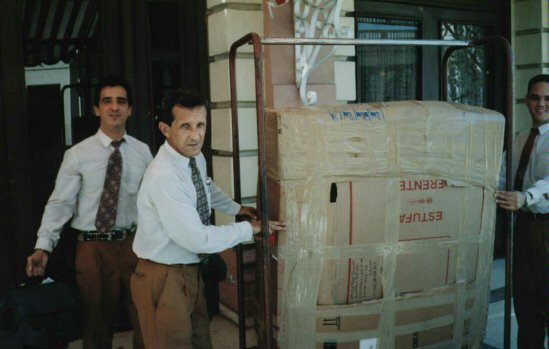
"Frankenbox" saves the day, Bikes safely packed for export to Mexico

"Frankenbox" saves the day, Bikes safely packed for export to Mexico

Photo Essay

The (not) crowded autopista; rules do not abound Principles of the California Clean Air Act do not apply in Cuba At least there are wheels on this vehicle One fifties relic towing another as the towee waves for the camera
Cuba photos →